
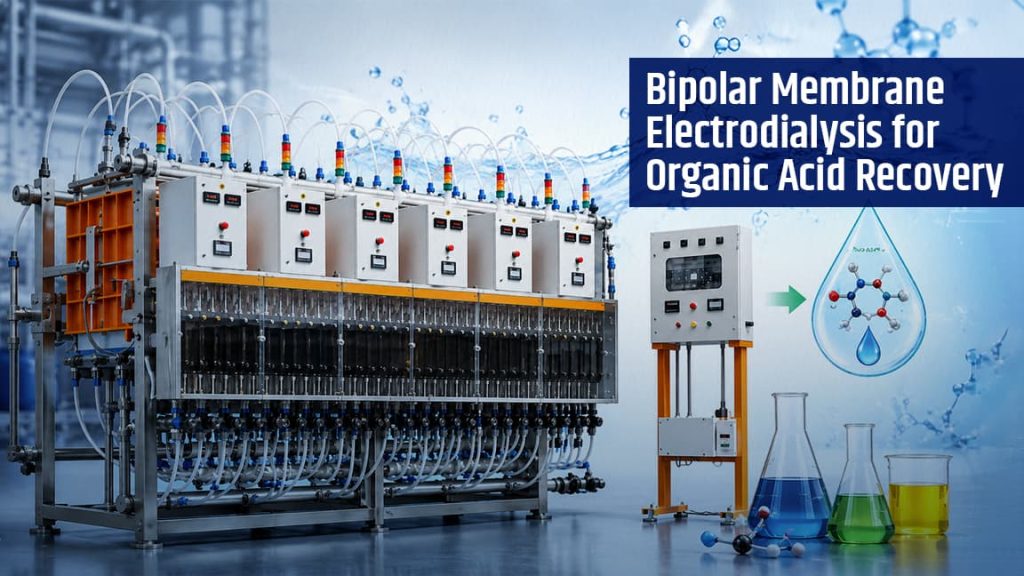
Every organic acid producer we meet asks us the same question. Can we stop buying so much sulphuric acid and caustic soda? The answer, in most cases, is yes. Bipolar membrane electrodialysis lets you split your own salt stream back into acid and base, right inside your plant. We have been building these stacks for years at our Kolhapur works, and this guide explains how the process actually behaves in production.
What Bipolar Membrane Electrodialysis Really Does
Conventional electrodialysis moves ions from one stream to another. It separates, but it does not create anything new. EDBM goes one step further.
A bipolar membrane sits inside the stack and splits water into H+ and OH- ions. Those ions then combine with the salt ions already present. Sodium lactate becomes lactic acid on one side and caustic soda on the other. No extra reagent is needed. Only DC power and water.
The stack itself is built from ion exchange membranes arranged in alternating pairs, so the direction each ion travels is fixed by membrane charge rather than by any added chemical.
That single difference changes your cost sheet. Instead of buying acid and selling gypsum waste, you regenerate both streams and reuse them.
Why Organic Acid Plants Benefit the Most
Fermentation gives you a salt, not an acid. Lactic fermentation produces sodium lactate. Citric fermentation is neutralised to citrate. Gluconate comes out the same way.
Traditionally, plants add sulphuric acid to free the acid. Then they filter out calcium sulphate and pay to dump it. It works, but the waste bill keeps climbing.
With EDBM, you skip that step entirely. As a result, three things improve at once:
-
Reagent purchase drops sharply, often by more than half
-
Solid gypsum waste falls close to zero
-
Product purity rises because you avoid sulphate contamination
Besides the savings, your effluent load becomes far easier to manage. Published electrodialysis based zero liquid discharge research reports the same pattern across industrial streams.
Two Compartment or Three Compartment: Choosing the Right Stack
This is where most enquiries go wrong. People ask for an EDBM plant without knowing which configuration suits their stream. We always start here.
Two compartment EDBM uses a bipolar membrane paired with one ion exchange membrane. It suits cases where you mainly need the acid, or mainly need the base. We use this setup for citric acid production, amino acid production and Vitamin C manufacture.
Three compartment EDBM adds a middle chamber. The feed salt enters the centre. Acid leaves from one side, base from the other. Both products come out reasonably clean. Lactic acid, gluconic acid, salicylic acid and methanesulphonic acid recovery all run better on this arrangement.
If you want to go deeper into the electro-membrane process fundamentals behind these two layouts, the theory is well documented. A full list of the configurations we supply is available on our Electrodialysis Machines and Applications page, which maps each acid to its recommended stack type.
Numbers Our Clients Actually See
We prefer to talk in figures rather than adjectives. Based on the plants we have commissioned, here is a realistic band.
We prefer to talk in figures rather than adjectives. Based on the plants we have commissioned, here is a realistic band.
| Parameter | Typical Range |
|---|---|
| Acid concentration achieved | 1.0 to 2.5 mol per litre |
| Conversion of salt to acid | 80 to 95 percent |
| Specific energy consumption | 1.0 to 2.5 kWh per kg of acid |
| Reduction in reagent purchase | 50 to 80 percent |
| Membrane service life | 3 to 7 years with correct pretreatment |
| Payback period | 14 to 30 months |
Payback depends heavily on your local power tariff and your current acid price. Therefore, we always run the calculation on your own data before quoting.
Pretreatment Decides Whether Your Stack Survives
Membranes do not fail on their own. They fail because someone fed them the wrong liquid. We have seen it too often, so we are direct about this with every client.
Divalent hardness is the first enemy. Calcium and magnesium will scale the bipolar membrane surface and drive up stack voltage. Keep combined hardness below roughly 0.5 ppm. Softening or chelating resin ahead of the stack is not optional.
Suspended solids and cell debris come next. A fermentation broth needs microfiltration or ultrafiltration first. Otherwise the flow channels blind within weeks.
Finally, watch for multivalent anions and heavy metals. Even trace iron will poison an anion exchange membrane over time.
Get these three right and your membranes will run for years. Ignore them and no stack design will save the plant.
How We Build and Deliver an EDBM Plant
Our approach has stayed the same for four decades across all our process equipment lines. We keep it simple and we keep it modular.
-
Pilot run. For larger investments, we build a pilot skid on order so you can test on live broth at your own our works at Kolhapur.
-
Process design. We fix membrane area, cell pair count, stage arrangement and rectifier rating from real data, not from a catalogue.
-
Fabrication. The plant is built as a skid mounted, fully automated, touch operated unit at our MIDC Gokul Shirgaon facility.
-
Erection and training. Our service engineers commission the plant and train your operators on cleaning cycles and current control.
-
Aftercare. Membrane replacement, CIP protocol tuning and performance audits continue afterwards.
You can read more about how we work and what we manufacture on our Electrodialysis and EDBM plant homepage. If your stream is a spent acid or spent caustic rather than a fermentation broth, our note on acid and alkali recovery by electrodialysis covers that route instead.
Common Questions We Get Asked
Question: Is bipolar membrane electrodialysis suitable for small batch producers?
Answer: Yes. Even a modest unit pays back when your acid consumption is steady.
Question: How pure is the recovered acid?
Answer: Purity depends on feed quality and stack type. Three compartment EDBM typically delivers acid clean enough for direct process reuse. Polishing may be needed for food grade output.
Question: What power supply does the plant need?
Answer: A DC rectifier sized to your stack. Most of our units run on standard three phase industrial supply.
Question: Can EDBM handle high salt concentration?
Answer: It handles moderate to high concentrations well. Very Low salinity streams are better staged, with conventional electrodialysis concentrating first and EDBM splitting afterwards.
Question: Does it work alongside our existing evaporator?
Answer: It does, and that combination usually gives the best economics. EDBM removes the salt load, so your evaporator handles far less material.
Talk to Us Before You Finalise Your Process
Before you shortlist a supplier, it also helps to read our note on choosing the right electrodialysis plant manufacturer, and our summary of the benefits of electrodialysis for chemical plants.