
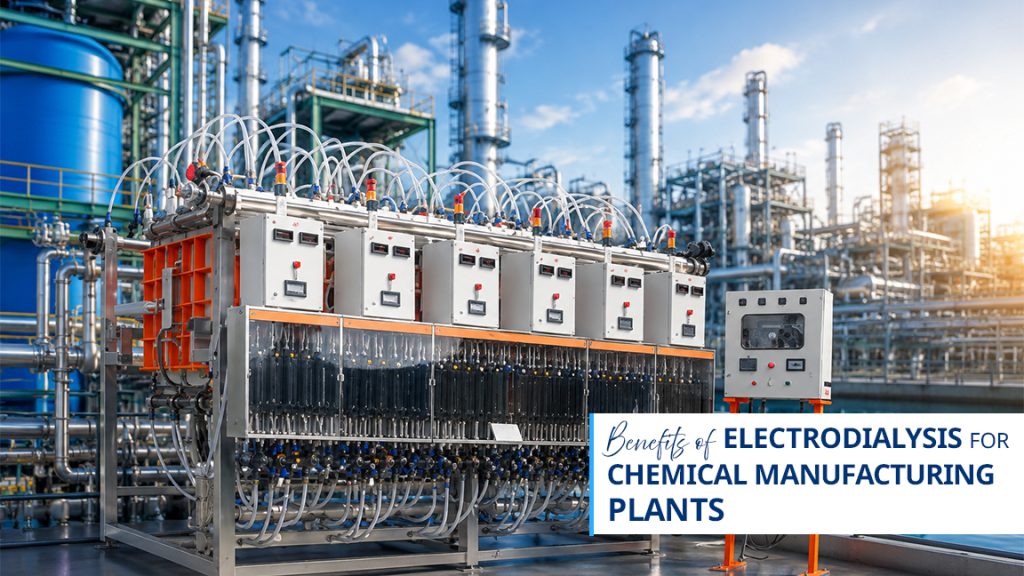
The chemical manufacturing industry constantly seeks innovative technologies that improve operational efficiency while reducing production costs and environmental impact. One technology that has gained significant attention is electrodialysis (ED), a membrane-based separation process that uses an electric field to selectively move dissolved ions through ion-exchange membranes.
Unlike conventional separation methods that often require high energy consumption or additional chemicals, electrodialysis offers an efficient, sustainable, and cost-effective solution for water purification, wastewater treatment, chemical recovery, and process optimization. Today, chemical manufacturing plants across various sectors, from specialty chemicals and dairy processing to battery manufacturing and recycling, are integrating electrodialysis systems to enhance productivity while meeting increasingly stringent environmental regulations.
In this article, we’ll explore the key benefits of electrodialysis for chemical manufacturing plants and why it has become an essential technology for modern industrial operations.
What is Electrodialysis?
Electrodialysis is an advanced membrane separation technology that removes dissolved salts and ions from liquids by applying a direct electric current. The process uses alternating cation-exchange and anion-exchange membranes that selectively transport positively and negatively charged ions.
Unlike reverse osmosis, electrodialysis primarily separates ions rather than water, making it particularly effective for treating solutions with moderate salinity and recovering valuable chemicals from industrial streams.
Major Benefits of Electrodialysis in Chemical Manufacturing
1. Efficient Chemical Recovery
One of the biggest advantages of electrodialysis is its ability to recover valuable chemicals from industrial process streams.
Many chemical plants generate wastewater containing acids, alkalis, salts, and other valuable compounds. Instead of disposing of these materials, electrodialysis enables manufacturers to recover and reuse them within the production process.
Benefits include:
-
Reduced raw material consumption
-
Lower disposal costs
-
Increased resource efficiency
-
Improved process sustainability
Chemical recovery not only saves money but also supports circular manufacturing practices.
2. Reduced Wastewater Treatment Costs
Wastewater treatment represents a significant operational expense for chemical manufacturing facilities.
Electrodialysis effectively removes dissolved salts and contaminants from wastewater, allowing plants to recycle treated water or safely discharge it according to environmental standards.
Advantages include:
-
Lower chemical treatment requirements
-
Reduced sludge generation
-
Lower operating expenses
-
Compliance with environmental regulations
Many facilities use electrodialysis as part of a zero liquid discharge (ZLD) strategy to minimize wastewater disposal.
3. Lower Energy Consumption
Compared to thermal separation technologies such as evaporation or distillation, electrodialysis consumes significantly less energy, especially when treating low to medium salinity streams.
Because only dissolved ions are transported through membranes rather than evaporating water, energy requirements remain relatively low.
This translates into:
-
Lower electricity costs
-
Reduced carbon emissions
-
Improved overall process efficiency
-
Better sustainability performance
Energy savings become even more significant in continuous industrial operations.
4. High Product Purity
Chemical manufacturers require high-purity products to maintain consistent quality standards.
Electrodialysis selectively removes unwanted ionic impurities without affecting many non-ionic compounds, making it suitable for:
-
Specialty chemicals
-
Pharmaceutical intermediates
-
Fine chemicals
-
High-purity industrial chemicals
Improved product purity helps reduce downstream processing while enhancing final product quality.
5. Water Reuse and Recycling
Water scarcity has become a major challenge for industrial facilities worldwide.
Electrodialysis enables chemical plants to recycle process water by removing dissolved contaminants, allowing treated water to be reused for various applications including:
-
Cooling systems
-
Boiler feed water
-
Process water
-
Cleaning operations
Water recycling reduces freshwater consumption while lowering operating costs.
6. Compact and Scalable Technology
Modern electrodialysis systems feature modular designs that can easily scale according to production requirements.
Whether serving small specialty chemical manufacturers or large industrial facilities, electrodialysis units can be customized based on:
-
Flow rate
-
Water quality
-
Salt concentration
-
Recovery targets
This flexibility makes the technology suitable for both new installations and existing plant upgrades.
7. Reduced Chemical Usage
Traditional wastewater treatment often relies heavily on chemical additives for precipitation, neutralization, or ion removal.
Electrodialysis minimizes the need for such chemicals because separation occurs through electrically driven ion migration.
Benefits include:
-
Lower chemical procurement costs
-
Reduced handling of hazardous substances
-
Safer working environments
-
Less secondary waste generation
This contributes to greener manufacturing practices.
8. Improved Environmental Compliance
Environmental regulations governing industrial wastewater discharge continue to become more stringent.
Electrodialysis helps chemical manufacturers meet these standards by effectively reducing:
-
Total dissolved solids (TDS)
-
Salt concentration
-
Ionic contaminants
-
Process waste
By improving wastewater quality, companies can avoid regulatory penalties while strengthening their environmental reputation.
9. Supports Sustainable Manufacturing
Sustainability has become a strategic priority across the chemical industry.
Electrodialysis contributes to sustainability by:
-
Conserving water resources
-
Recovering valuable chemicals
-
Reducing waste generation
-
Lowering greenhouse gas emissions
-
Improving energy efficiency
These advantages align with ESG (Environmental, Social, and Governance) goals while supporting long-term operational resilience.
Applications of Electrodialysis in Chemical Manufacturing
Electrodialysis is widely used across multiple chemical manufacturing processes, including:
-
Acid and alkali recovery
-
Salt removal from process streams
-
Process water purification
-
Wastewater treatment
-
Brine concentration
-
Chemical recycling
-
Production of specialty chemicals
-
Industrial water reuse systems
Its versatility makes electrodialysis a valuable solution for both commodity and specialty chemical manufacturers.
Specific Industry Applications
Beyond general process use, electrodialysis is deployed in several highly specific industrial applications:
-
Manufacture of colloidal silica. Electrodialysis removes unwanted ionic impurities during silica production, delivering stable, high-purity colloidal silica without the additional chemical dosing required by conventional methods.
-
Desalination of cheese and paneer whey in dairies. Dairy processors use electrodialysis to reduce the salt content of cheese and paneer whey, converting a low-value by-product into a usable ingredient for food and nutrition applications while cutting effluent load.
-
Recovery of acid and alkali from battery recycling wastewater. In battery manufacturing and recycling operations, electrodialysis recovers acids and alkalis from process wastewater so they can be returned to production, lowering both raw material and disposal costs.
-
Removal of salts from organic acids and other organic compounds. Electrodialysis selectively strips ionic salts from organic acid streams and similar compounds, improving purity without degrading heat-sensitive organic molecules.
Conclusion
Electrodialysis has become an essential technology for modern chemical manufacturing plants seeking greater efficiency, sustainability, and cost savings. By enabling chemical recovery, reducing wastewater treatment expenses, conserving water, and improving product quality, electrodialysis delivers both economic and environmental benefits.
As industries continue to prioritize resource conservation and regulatory compliance, from specialty chemicals and dairy processing to battery manufacturing and recycling, adopting electrodialysis systems can provide a competitive advantage while supporting long-term sustainable growth. Whether the goal is reducing operational costs, recovering valuable chemicals, or minimizing environmental impact, electrodialysis offers a reliable and future-ready solution for today’s chemical manufacturing sector.
Contact us today to discuss your project and explore how electrodialysis can enhance your manufacturing operations.
Contact Us Today
Website:https://www.electrodialysis.in/
Email:[email protected]
Phone: +91 9422417760
Address: H16, Maharashtra Industrial Development Corporation, Gokul-Shirgaon, Dist. Kolhapur, 416234 Maharashtra State, INDIA.
Request a Free Consultation and let our team help you find the most efficient and cost-effective electrodialysis solution for your business.
Frequently Asked Questions (FAQs)
1. What is electrodialysis used for in chemical manufacturing?
Electrodialysis is used for chemical recovery, desalination, wastewater treatment, water recycling, salt removal, and purification of industrial process streams.
2. How does electrodialysis reduce operating costs?
It lowers energy consumption, minimizes chemical usage, enables water reuse, and recovers valuable chemicals that can be recycled back into production.
3. Is electrodialysis environmentally friendly?
Yes. Electrodialysis reduces wastewater generation, conserves water, decreases chemical consumption, and supports sustainable manufacturing practices.
4. Which industries benefit from electrodialysis?
Industries including specialty chemical manufacturing, dairy, pharmaceuticals, food and beverage, power generation, textile processing, battery manufacturing and recycling, mining, and water treatment benefit from electrodialysis technology.
5. Why is electrodialysis better than traditional separation methods?
Electrodialysis offers lower energy consumption, selective ion removal, reduced chemical usage, high recovery rates, and easier scalability compared to many conventional separation technologies.