
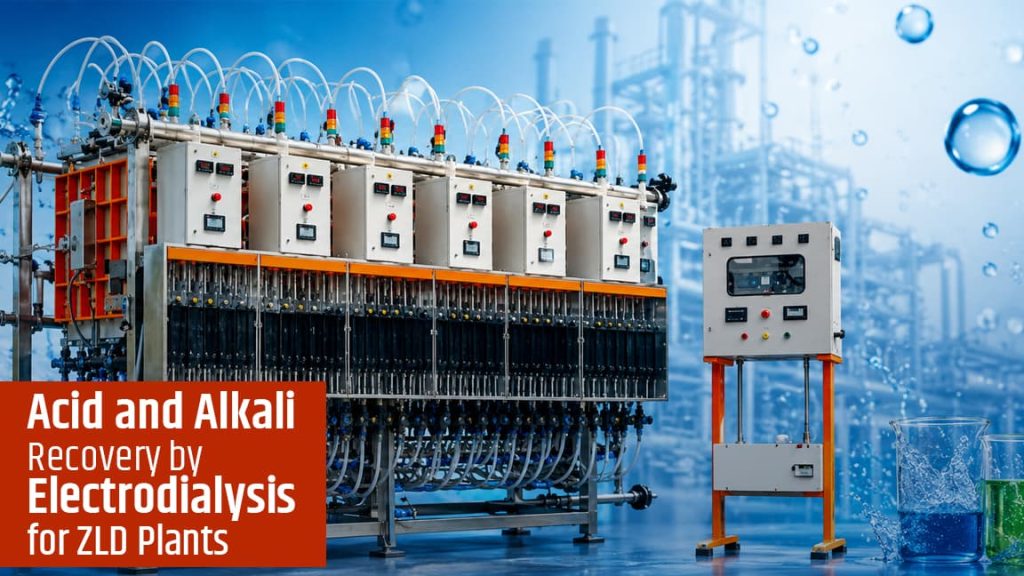
Pollution norms in India have tightened, and most chemical, pharma and textile units now carry a zero liquid discharge target. At the same time, caustic and acid prices keep moving up. Acid and alkali recovery by electrodialysis solves both problems with one system. We build these plants at Laxminarayan Technologies, and this article covers what actually happens when you install one.
The Real Cost of Neutralise and Dump
Most plants still follow the old route. You neutralise the spent stream, you send it to the evaporator, and you cart away the salt. It is familiar, but it is expensive in three separate ways.
First, you pay for fresh acid and fresh alkali every month. Second, you pay for the power your evaporator burns on a large volume. Third, you pay for hazardous salt disposal, and that cost keeps rising.
Acid and alkali recovery breaks this loop. Instead of destroying two chemicals to make waste, you recover both and feed them back into the process.
How the Recovery Actually Works
The heart of the system is a membrane stack. Charged ion exchange membranes are stacked between two electrodes. When DC voltage is applied, cations move one way and anions move the other.
For simple desalting, conventional electrodialysis is enough. It pulls salt out of your stream and concentrates it into a small brine volume. Where fouling is a concern, plants often prefer polarity reversal, and this short explainer on how electrodialysis reversal works describes the cycle well.
For genuine chemical recovery, we add bipolar membranes. Water splits at the bipolar interface, and the salt is converted back into its parent acid and base. Sodium sulphate returns as sulphuric acid and caustic soda. Sodium chloride returns as hydrochloric acid and caustic soda.
Because there is no phase change, the energy demand stays far below thermal routes. That single fact is why membrane recovery keeps replacing evaporation wherever the chemistry allows. For fermentation derived streams specifically, our guide to bipolar membrane electrodialysis for organic acid recovery goes into the stack configurations in detail.
Where Electrodialysis Fits in a ZLD Train
Electrodialysis rarely works alone. It performs best as the concentration stage between RO and the evaporator.
A typical scheme runs like this:
-
Pretreatment removes solids, hardness and organics
-
Reverse osmosis recovers the bulk of clean water
-
Electrodialysis concentrates the RO reject to a much higher salinity
-
Bipolar electrodialysis splits the concentrated salt into acid and alkali
-
A small evaporator or crystalliser finishes whatever remains
The advantage is straightforward. RO stalls at around 70 to 75 g per kg of salinity. Electrodialysis pushes well beyond that. Consequently, the volume reaching your evaporator shrinks dramatically, and so does your steam bill. A broad zero liquid discharge technology review reaches the same conclusion on staging, and a focused electrodialysis based ZLD study puts numbers to the energy saving.
Industries Where We See the Fastest Payback
Not every plant is a good fit. These are the sectors where the numbers usually work quickly.
Specialty chemicals. Spent acid and spent caustic streams are steady and reasonably clean. Recovery is direct.
Pharma intermediates. High reagent consumption and strict effluent limits make the case easy.
Textile dyeing and finishing. Caustic recovery from mercerising liquor is a proven application with short payback.
Metal finishing and plating. Recovery of nickel and chromium salts from rinse water saves both chemical and disposal cost.
Food, dairy and beverage. Demineralisation, dealkalisation and deacidification all run on the same platform.
Phase transfer catalyst and colloidal silica manufacture. These are core applications for us, and both are listed on our applications and stack configuration chart.
Electrodialysis Compared with the Alternatives
| Criterion | Electrodialysis | Reverse Osmosis | Evaporation |
|---|---|---|---|
| Maximum salinity handled | Very high | Limited | Very high |
| Energy demand | Low to moderate | Low | High |
| Tolerance to silica | High | Low | High |
| Tolerance to turbidity | Moderate to high | Low | High |
| Recovers usable chemicals | Yes with EDBM | No | No |
| Membrane or tube life | 3 to 7 years | 1.5 to 3 years | Long |
| Capital cost | Moderate | Low | High |
Reverse osmosis remains the right choice for bulk water recovery. Evaporation still handles the final residue. Electrodialysis sits between them and does the job neither can do well.
What We Check Before Designing Your Acid and Alkali Recovery Plant
We do not quote from a standard price list, because no two effluents behave alike. Our design starts with a short study.
We ask for the full ionic profile of the stream, not just TDS. We check hardness, silica, COD and any heavy metal traces. We look at flow variation across the day and across the season. We confirm your target acid and alkali strength, since that decides stack size more than anything else. Finally, we look at your power tariff, because operating cost decides the payback.
Once these are clear, we run a bench trial and give you honest numbers. If electrodialysis is not the right answer for your stream, we tell you that too. Our wider note on the benefits of electrodialysis for chemical manufacturing plants explains where the technology genuinely earns its place.
Regulatory Pressure Is Not Going Away
The Central Pollution Control Board and state boards have steadily expanded ZLD requirements across industrial categories. Inspection is stricter and consent renewals now depend on demonstrated compliance.
Viewing ZLD purely as a compliance expense is a mistake, though. When you recover acid and alkali, the same investment returns money every month. Plants that installed recovery early are now running at lower chemical cost than their competitors.
In other words, the regulation forced a decision that turned out to be commercially sound anyway.
Frequently Asked Questions
Question: How much chemical can we realistically recover?
Ans: Most installations recover 60 to 85 percent of the acid and alkali value from a suitable stream. Actual figures depend on feed purity.
Question: What is the typical payback on an acid and alkali recovery plant?
Ans: Between 18 and 36 months for medium sized units. Plants with high reagent spend often see faster returns.
Question: Will the recovered chemicals be strong enough to reuse?
Ans: Yes, in most process applications. We normally design for 1 to 2 mol per litre, which suits direct recycle in the plant.
Question: Can the system handle variable effluent flow?
Ans: It can, with buffer tanks and automated current control. Our plants are fully automated and touch operated for this reason.
Question: Do you supply pilot plants?
Ans: We do No. However, Pilot unit is made available at our works on request order so you can validate performance before committing to a commercial plant.
Question: Where are your plants installed?
Ans: We have supplied process equipment to clients across India and overseas, including installations in Israel and several Indian industrial clusters.
Let Us Study Your Effluent for Acid and Alkali Recovery
If your plant is under ZLD pressure and your chemical bill keeps rising, the two problems are connected. Solving them together is usually cheaper than solving them separately.
Share your effluent analysis with us and we will tell you plainly whether acid and alkali recovery by electrodialysis fits your case. If it does, we will design, build, erect and commission the plant, and train your team to run it.
Reach us on +91 9422417760 or through our enquiry form. Our works are at H16, MIDC Gokul Shirgaon, Kolhapur 416234, Maharashtra, India.