
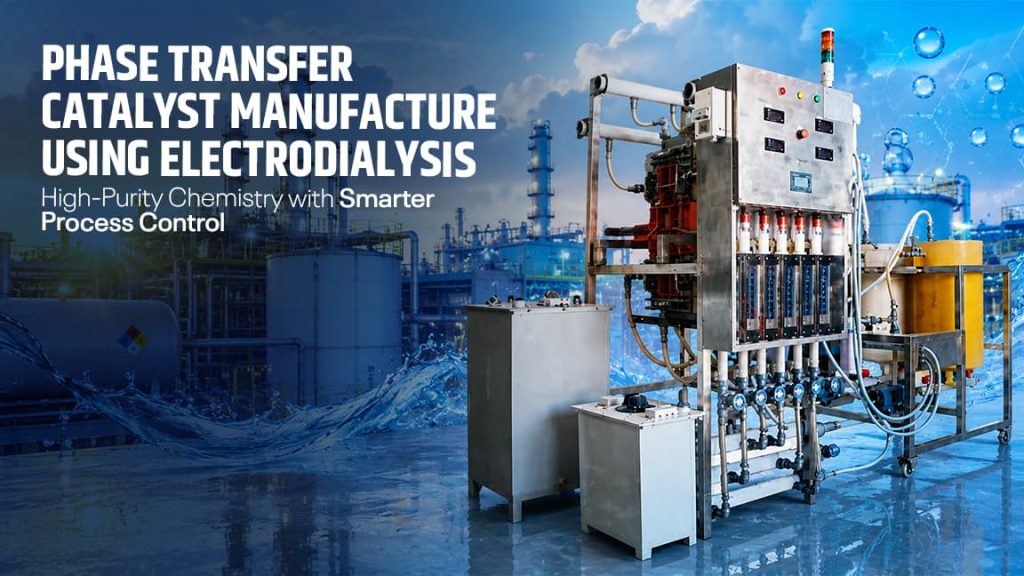
Phase transfer catalysts play an important role in modern chemical synthesis by enabling reactants from different phases to react more efficiently. They are widely used in organic synthesis, specialty chemicals, pharmaceuticals, agrochemicals, polymers, zeolites, printed-circuit manufacturing, and semiconductor processing.
As industries demand higher purity, lower chemical waste, and more reliable production economics, electrodialysis and bipolar electrodialysis are gaining attention as advanced technologies for phase transfer catalyst manufacture.
The Phase Transfer Catalyst Manufacture process developed by Laxminarayan Technologies is designed for preparing or purifying onium hydroxides of nitrogen, sulphur, and phosphorus using electrodialysis or EDBM technology.
What Is a Phase Transfer Catalyst?
A phase transfer catalyst helps move a reactive species from one phase into another, usually between an aqueous phase and an organic phase. This allows chemical reactions to proceed more efficiently without requiring both reactants to be soluble in the same medium.
Phase transfer catalysts can help improve:
-
Reaction rate
-
Conversion efficiency
-
Selectivity
-
Solvent utilisation
-
Process flexibility
-
Production throughput
-
Operating economics
Quaternary ammonium compounds are among the most widely used phase transfer catalysts. Other important onium compounds include phosphonium and sulphonium-based materials.
What Are Onium Hydroxides?
Onium hydroxides are positively charged organic compounds associated with hydroxide ions. They are strong organic bases and can be manufactured or purified using membrane-based electrochemical processes.
Examples include:
-
Tetramethylammonium hydroxide, or TMAH
-
Tetraethylammonium hydroxide, or TEAH
-
Tetrapropylammonium hydroxide
-
Tetra-n-octylammonium hydroxide
-
Benzyltrimethylammonium hydroxide
-
Benzyltriethylammonium hydroxide
-
Selected pyridinium and imidazolinium hydroxides
The final product depends on the feed salt, target concentration, purity requirements, membrane configuration, and downstream processing conditions.
Why High Purity Matters
Many applications require phase transfer catalysts with very low levels of unwanted ions. Residual halides, sulphates, carbonates, and alkali-metal ions can affect reaction performance, product quality, and process reliability.
High-purity onium hydroxides are particularly important in:
-
Semiconductor manufacturing
-
Printed-circuit production
-
Photoresist development
-
Zeolite synthesis
-
Pharmaceutical intermediates
-
Specialty chemical production
-
Organic synthesis
-
Electrochemical analysis
In these applications, small variations in ionic contamination can influence reaction selectivity, surface quality, or downstream product performance.
How Electrodialysis Produces Onium Hydroxides
Quaternary ammonium hydroxides can be prepared by electrodialysis of the corresponding quaternary ammonium salt.
Common feed salts may include:
-
Quaternary ammonium chlorides
-
Quaternary ammonium bromides
-
Quaternary ammonium carbonates
-
Quaternary ammonium carboxylates
-
Quaternary ammonium sulphates
The electrodialysis stack contains alternating ion-exchange membranes, seals, electrodes, and flow compartments. When direct current is applied, ions move selectively through the membranes according to their charge.
The process can separate the unwanted counterion from the organic cation and generate the required hydroxide form in solution.
Conventional Manufacturing Challenges
Traditional chemical conversion routes can require additional reagents, create salt by-products, and increase purification requirements. Depending on the chemistry, conventional processes may lead to:
-
Higher chemical consumption
-
Additional neutralisation steps
-
Increased salt formation
-
More wastewater
-
Greater purification load
-
Variable product quality
-
Higher operating complexity
For high-purity applications, these challenges can increase the cost of achieving the required specification.
Electrodialysis offers a more controlled approach by using selective membranes and an electric field to drive ionic separation.
Advantages of Electrodialysis for Phase Transfer Catalyst Manufacture
High-Purity Product Potential
Selective ion transport can support the production of onium hydroxide solutions with low levels of unwanted counterions and inorganic impurities.
Reduced Chemical Addition
The process can reduce dependency on conventional chemical conversion and neutralisation steps. Actual chemical requirements depend on the selected feed chemistry and plant configuration.
Lower Salt Generation
Because electrodialysis directly separates ions through membranes, it can reduce the formation of unwanted salt by-products compared with some conventional routes.
Flexible Feed Chemistry
The technology can be adapted to a range of quaternary ammonium salts and other onium compounds, subject to laboratory and pilot validation.
Better Process Control
Current density, flow rate, temperature, concentration, and membrane configuration can be monitored and controlled to achieve more consistent operation.
Modular Plant Design
Electrodialysis systems can be designed for pilot-scale development as well as commercial production. The stack area and number of cell pairs can be selected according to the required capacity.
Lower Environmental Burden
Reduced chemical dosing and improved ion separation can help lower wastewater generation and simplify downstream treatment.
Frequently Asked Questions
Questions: What is phase transfer catalyst manufacture?
Phase transfer catalyst manufacture is the production or purification of compounds that transfer reactive ions between immiscible phases, helping chemical reactions proceed more efficiently.
Questions: How are quaternary ammonium hydroxides produced?
Quaternary ammonium hydroxides can be produced by electrodialysis of quaternary ammonium salts such as chlorides, bromides, carbonates, or carboxylates.
Questions: What is the role of electrodialysis?
Electrodialysis uses ion-exchange membranes and direct current to selectively transport ions and convert or purify the feed solution.
Questions: What is EDBM?
EDBM means bipolar electrodialysis. It uses bipolar membranes that split water into hydrogen and hydroxide ions, enabling selected salt-conversion and acid-alkali production processes.
Questions: Which phase transfer catalysts can be manufactured?
The process can be evaluated for quaternary ammonium, phosphonium, sulphonium, pyridinium, and other onium compounds, depending on the feed salt and target product.
Questions: Why is TMAH important?
Tetramethylammonium hydroxide, or TMAH, is a strong organic base used in photoresist development, printed-circuit production, semiconductor processing, and chemical synthesis.
Questions: Can electrodialysis reduce wastewater?
Electrodialysis can reduce chemical waste and salt formation in suitable applications. The actual wastewater profile depends on feed quality, cleaning requirements, membrane configuration, and overall plant design.
Questions: Is pilot testing necessary?
Yes. Pilot testing helps confirm membrane compatibility, current efficiency, product purity, energy consumption, concentration limits, and long-term process stability.
The Electrodialysis Stack: Core Technology Explained
The electrodialysis stack is the central component of the process. It normally includes:
-
Anode and cathode assemblies
-
Cation-exchange membranes
-
Anion-exchange membranes
-
Bipolar membranes, where required
-
Spacers and flow channels
-
Seals and gaskets
-
Feed and product manifolds
-
Electrical connections
When voltage is applied, positively charged ions migrate toward the cathode and negatively charged ions migrate toward the anode. Ion-exchange membranes permit selected ions to pass while restricting others.
In a bipolar electrodialysis configuration, water dissociation at the bipolar membrane can provide hydrogen and hydroxide ions. This enables the conversion of selected salts into useful acid and alkaline products.
Applications of Phase Transfer Catalysts
Organic Synthesis
Phase transfer catalysts help improve reactions involving reactants dissolved in different phases. They are used in alkylation, oxidation, substitution, condensation, and other synthetic processes.
Pharmaceutical Manufacturing
Pharmaceutical intermediates often require controlled reaction conditions and high-purity reagents. Phase transfer catalysts can support efficient synthesis and improved process productivity.
Agrochemical Production
Many agrochemical molecules are manufactured through multiphase reactions. Phase transfer catalysts can help improve reaction contact and reduce processing limitations.
Semiconductor and Printed-Circuit Manufacturing
Aqueous TMAH solutions are widely associated with photoresist development. High purity is important because metallic or ionic contamination can affect sensitive electronic manufacturing processes.
Zeolite Manufacturing
Quaternary ammonium hydroxides with larger organic substituents can be used in zeolite synthesis. Low alkali-metal contamination may be especially important in this application.
Chemical Analysis
Some quaternary ammonium hydroxides are used as strong organic bases for titration and analytical applications.
Related Electrodialysis Technologies and Applications
Manufacturers interested in phase transfer catalyst production may also benefit from other membrane-based process solutions.
Colloidal Silica Manufacture
Colloidal Silica Manufacture Using Electrodialysis uses the Electrosol process to dealkalise sodium silicate and produce aqueous silica sol.
The process is designed to reduce acid consumption, recycle filtrate, minimise process-water use, and recover sodium as caustic soda lye.
Acid and Alkali Recovery
Bipolar Electrodialysis for Acid and Alkali Recovery can convert selected inorganic salts and industrial waste streams into corresponding acids and bases.
This technology can support chemical recovery, process reuse, and zero-liquid-discharge strategies.
Desalination of Chemical Intermediates
Electrodialysis for Desalination of Pharmaceutical and Chemical Intermediates can remove unwanted ionic components from valuable product streams.
This is useful when the target product must be retained while salts and other charged impurities are reduced.
Organic Acid Production
Electrodialysis for Organic Acid Production can be evaluated for converting organic acid salts into their corresponding acids.
EDBM can provide hydrogen and hydroxide ions without introducing additional salt into the process, subject to the chemistry and process configuration.
Electrodialysis Machines and Applications
Explore the complete Electrodialysis Machines and Applications portfolio for solutions covering desalination, chemical recovery, organic acids, food processing, pharmaceutical intermediates, and specialty chemicals.
Latest Technology Trends in Phase Transfer Catalyst Production
Modern chemical plants are moving toward process systems that are cleaner, more automated, and easier to scale. The most important technology trends include:
Membrane-Based Separation
Membrane processes reduce the need for repeated chemical conversion and can provide more selective ion separation.
Bipolar Membrane Technology
EDBM enables salt conversion and acid-alkali generation in suitable systems, creating opportunities for resource recovery and lower waste generation.
Automated Process Control
PLC-based controls, online sensors, automated dosing, current control, alarms, and data logging can improve process repeatability.
Modular Plant Architecture
Modular stacks and skid-mounted systems make it easier to develop pilot plants, expand capacity, and adapt the process to new product grades.
Resource Recovery
Modern plants increasingly focus on recovering useful acids, alkalis, and chemical intermediates instead of treating them as waste.
Digital Process Monitoring
Online monitoring of conductivity, pH, temperature, flow, pressure, voltage, and current can help operators identify process deviations earlier.
Sustainability by Design
Reduced chemical consumption, lower wastewater generation, and improved product recovery are becoming important factors in plant selection and investment decisions.
Global Application of Electrodialysis Technology
Electrodialysis and bipolar electrodialysis are relevant to chemical manufacturers across multiple regions and industries.
Laxminarayan Technologies provides process solutions for customers evaluating:
-
Pilot-scale development
-
Commercial-scale production
-
Specialty chemical manufacture
-
High-purity hydroxide production
-
Chemical desalination
-
Acid and alkali recovery
-
Zero-liquid-discharge systems
-
Resource-recovery applications
For international projects, plant planning should consider local electrical standards, feedstock quality, membrane servicing, operator training, safety requirements, logistics, and regulatory compliance.
How to Select a Phase Transfer Catalyst Electrodialysis Plant
Before finalising a plant design, manufacturers should review:
-
Feed salt composition: Identify the organic cation, counterion, concentration, and impurity profile.
-
Target product: Define the required hydroxide concentration, purity, stability, and grade.
-
Required capacity: Determine batch size, daily production, and expected future expansion.
-
Membrane compatibility: Validate that the selected membranes can handle the feed chemistry.
-
Current efficiency: Study power consumption and ion-transfer performance during pilot trials.
-
Product recovery: Assess how the product stream will be concentrated, stored, and packaged.
-
Impurity control: Establish acceptable limits for halides, sulphates, carbonates, metals, and other ions.
-
Automation level: Decide whether the plant requires PLC control, recipe management, data logging, or remote monitoring.
-
Cleaning strategy: Plan membrane cleaning, flushing, chemical compatibility, and maintenance intervals.
-
Safety systems: Include suitable electrical, chemical, ventilation, containment, and operator-protection measures.
-
Pilot validation: Confirm process performance before moving to commercial-scale production.
Why Pilot Trials Matter
The same electrodialysis configuration will not perform identically for every onium salt. Molecular structure, concentration, viscosity, conductivity, impurity level, membrane selectivity, and operating temperature all influence the final result.
A pilot trial can help establish:
-
Product purity
-
Current efficiency
-
Energy consumption
-
Membrane stability
-
Conversion rate
-
Product concentration
-
Water balance
-
Cleaning requirements
-
Operating limits
-
Scale-up parameters
Pilot testing is the sensible route when the target product has demanding purity requirements or when the feed chemistry is new.
Turnkey Project Support
A reliable phase transfer catalyst plant requires coordinated process and equipment engineering. The complete project may include:
-
Process selection
-
pilot testing
-
Electrodialysis stack design
-
Plant layout
-
Feed and product tanks
-
Pumps and piping
-
Electrical systems
-
PLC and HMI controls
-
Safety systems
-
Product concentration
-
Plant erection
-
Commissioning
-
Operator training
-
Quality-control planning
A turnkey approach helps ensure that the membrane stack, auxiliary systems, instrumentation, and downstream process are designed to work together.
The Future of Phase Transfer Catalyst Manufacture
The future of phase transfer catalyst production will be shaped by high-purity requirements, lower waste generation, better automation, and improved chemical recovery.
Electrodialysis and bipolar electrodialysis fit this direction because they provide:
-
Selective ion transport
-
Reduced chemical dependency
-
Flexible process design
-
Scalable production
-
Potentially lower waste generation
-
Better control of product purity
-
Opportunities for acid and alkali recovery
For manufacturers serving semiconductor, pharmaceutical, agrochemical, specialty chemical, and zeolite markets, membrane-based production can provide a more adaptable platform for future growth.
Conclusion
Electrodialysis offers an advanced route for the manufacture and purification of phase transfer catalysts, especially onium hydroxides derived from quaternary ammonium and related salts.
With selective ion-exchange membranes, controlled electrical operation, and optional bipolar membrane technology, the process can support high-purity products while reducing chemical conversion steps and unwanted waste.
The right solution depends on feed chemistry, target product specifications, plant capacity, membrane compatibility, and pilot-test results. Explore the Phase Transfer Catalyst Manufacture solution or visit the Electrodialysis.in homepage to discuss pilot plants, commercial systems, and turnkey project requirements.