
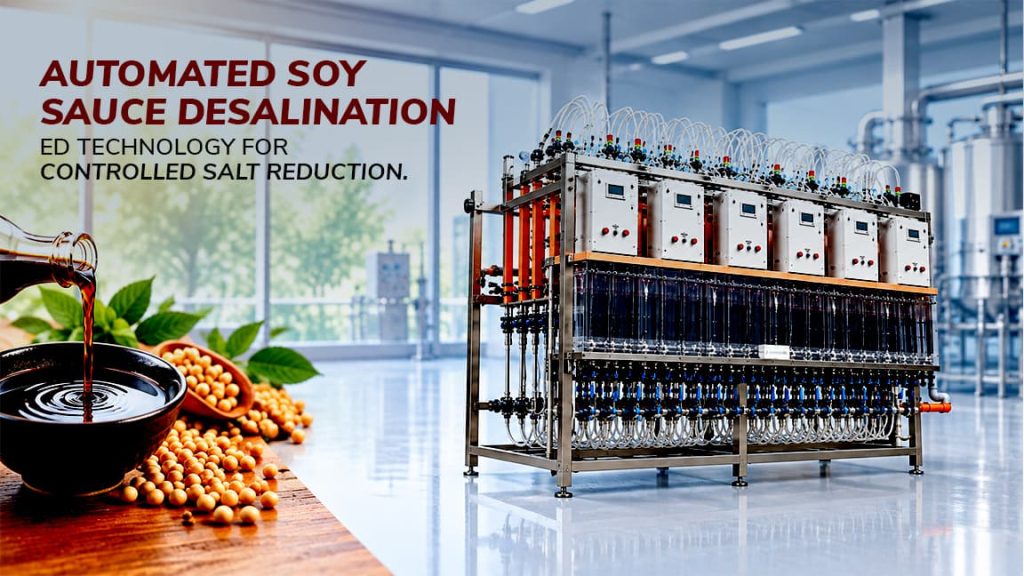
Electrodialysis for soy sauce desalination removes sodium chloride through cation- and anion-exchange membranes while retaining much of the sauce’s amino acids, colour, and non-salt solids. With controlled pH, current density, pretreatment, and cleaning, ED can support low-sodium soy sauce production without treating flavour like an expendable ingredient.
Why is soy sauce desalting difficult?
Soy sauce commonly contains about 16–20% sodium chloride. That salt protects the fermented product and shapes its taste, but customers and food manufacturers increasingly want lower-sodium formulations.
The problem is simple to describe and difficult to solve: remove NaCl without stripping away the amino acids, aroma compounds, colour, and body that make soy sauce recognisable.
Electrodialysis for soy sauce desalination gives us a selective route. At Laxminarayan Technologies, we design modular ED plants for food and fermentation streams, from pilot systems to fully automated commercial units. Our job is not just to lower conductivity. It is to hit the salt target while keeping the sauce commercially useful.
What is electrodialysis for soy sauce desalination?
Electrodialysis is an electrically driven membrane process that separates charged ions from liquid foods. Alternating cation-exchange membranes and anion-exchange membranes move sodium and chloride ions into a concentrate stream under direct current.
The treated sauce remains in the diluate stream. Uncharged compounds are mostly retained, although some charged amino acids and aroma compounds may also migrate. That last point matters. ED is selective, not psychic.
According to published soy sauce studies, desalination of around 64–75% has been achieved under controlled conditions, with flavour, colour, and taste retained in some trials. Results vary with pH, membrane type, current density, feed composition, and treatment time.
How to reduce salt in soy sauce using electrodialysis
A practical low-sodium soy sauce process usually follows a measured sequence:
-
Analyse the feed. Measure NaCl, conductivity, pH, amino nitrogen, total solids, colour, viscosity, and suspended particles.
-
Clarify the sauce. Microfiltration or suitable clarification can reduce solids that would otherwise foul the stack.
-
Select the membrane pair. Cation and anion membranes must suit the sauce chemistry, food-contact requirements, and cleaning programme.
-
Set the operating window. Control pH, flow velocity, current density, voltage, temperature, and batch time.
-
Track the product. Monitor salt reduction, amino nitrogen, colour, conductivity, volume, and sensory quality.
-
Recover the concentrate carefully. The salt-rich stream may contain useful flavour compounds and should not automatically be treated as waste.
-
Clean the stack. Rinse and perform chemical cleaning before deposits turn into a maintenance event.
A 2021 study reported an optimum laboratory condition near 5 mA/cm² and pH 5, producing 64% desalination with a total amino-acid loss rate of 29.8%. That is a useful research benchmark, not a universal plant recipe.
Can ED lower NaCl from 18% to 5–8%?
It can be technically feasible, but the answer depends on the original sauce and the required product quality. Reducing salt from approximately 18% to 5–8% may require staged operation, feed conditioning, a larger membrane area, or a carefully managed batch process.
Some studies have reduced salt from 19.4% to 9.1%, while other laboratory work reported reductions above 80%. Pushing the final salt level too aggressively can increase amino-acid and aroma losses. A pilot run tells us where the useful line sits.
How does a food-grade ED plant work?
An ED stack contains repeated cell pairs separated by spacers. The cation membrane allows positively charged ions to pass more easily. The anion membrane favours negatively charged ions. Sodium moves toward the cathode, chloride moves toward the anode, and both are directed into the concentrate channel.
The sauce channel is the diluate. The ion-rich channel is the concentrate or brine.
This is different from dilution. Adding water reduces salt concentration but also weakens the sauce and increases downstream evaporation demand. ED removes ions directly and can produce a lower-sodium product with less change in total solids concentration.
Our Laxminarayan Technologies systems can include automated pumps, flow control, conductivity probes, pH monitoring, recipe-based operation, alarms, and touch-operated controls. We build both pilot-scale and commercial ED plants, because a sauce that behaves well in a beaker may act rather differently across a full stack.
ED versus EDBM for food and fermentation streams
|
Feature |
Conventional ED |
EDBM |
|
Main purpose |
Salt removal and demineralization |
Salt splitting into acid and alkali |
|
Membranes |
Cation and anion exchange membranes |
Cation, anion, and bipolar membranes |
|
Soy sauce role |
NaCl reduction and low-sodium processing |
pH correction or recovery of acid and base from suitable salts |
|
Main product stream |
Desalted sauce plus concentrate |
Acid, alkali, and treated product streams |
|
Main control issue |
Amino-acid migration, fouling, and current efficiency |
Water splitting, pH control, scaling, and membrane stability |
Bipolar electrodialysis is more relevant where a plant needs acid or alkali recovery. For example, our organic acid production application shows how salt streams can become useful chemical products instead of disposal burdens.
How can producers make low-sodium soy sauce without losing flavour or colour?
This is the real process question.
Soy sauce flavour comes from amino acids, organic acids, alcohols, phenols, pyrazines, furans, and other fermentation products. Some compounds are charged at a given pH and can migrate through ion-exchange membranes. Smaller amino acids may move more readily than larger or less mobile molecules.
A controlled process should therefore include:
-
pH optimisation: Research indicates that pH 5–6 can reduce amino-acid loss compared with strongly acidic conditions.
-
Moderate current density: Increasing current speeds salt transfer only up to a point. Beyond the useful range, current efficiency can fall.
-
Shorter treatment stages: Staged desalination gives better control than one long, hard push.
-
Quality-by-design monitoring: Conductivity, voltage, current, sauce volume, salt, and non-salt solids should be tracked together.
-
Sensory testing: Colour and conductivity are not enough. Taste and aroma still get the final vote.
A 2019 study used near-infrared spectroscopy, conductivity probes, level measurement, and current control to model soy sauce desalting. That approach is valuable for a commercial line because it turns the ED plant from a timed black box into a measurable process.
According to research published in 2026, electrodialysis can reduce the intensity of several soy sauce odor compounds. That does not make ED unsuitable. It means aroma retention should be tested as part of product development, especially for premium sauces.
Applications beyond soy sauce desalting
An ED plant for food and fermentation can support several related operations:
-
Low-sodium soy sauce processing: Reduce NaCl while retaining target amino nitrogen and colour.
-
Fermented sauces and fish sauce: Control ionic strength and recover salt-rich side streams.
-
Whey and dairy ingredients: Apply cheese whey desalination for demineralization before concentration or drying.
-
Food-grade acid recovery: Use EDBM where organic acids or alkali must be recovered from salt solutions.
-
Chemical and water-recovery lines: Combine ED or EDBM with ZLD strategies, brine concentration, or wastewater recovery.
For other process examples, Laxminarayan Technologies also develops systems for aluminum foil pickling acid recovery and colloidal silica manufacture. Different feeds, same engineering rule: test the chemistry before sizing the stack.
Challenges and solutions in soy sauce ED
Membrane fouling
Soy sauce contains proteins, peptides, pigments, colloids, and other organic matter. These can form a layer on the membrane surface, much like a filter slowly choking with fine solids. Stack resistance rises, voltage creeps upward, and salt removal becomes less efficient.
Clarification, suitable flow velocity, membrane selection, and scheduled CIP help control the problem. We also recommend monitoring the difference between clean-stack voltage and operating voltage. That trend often tells the truth before the operator sees the deposit.
Amino-acid and aroma loss
Some amino acids are charged and may migrate with salt. Studies have reported losses near 30% under particular laboratory conditions, while other trials achieved substantial salt removal with limited sensory change.
The solution is not simply “use more current.” It is to tune pH, current density, membrane selectivity, residence time, and stage cut around the target sauce.
Current efficiency and scaling
Above the useful current range, water splitting, electro-convection, heating, and fouling can consume energy without delivering proportional salt removal. In one study, current efficiency fell rapidly above 5 mA/cm².
Our systems monitor voltage, current, pH, conductivity, temperature, flow, and pressure. That allows operators to identify a stressed stack before it becomes an expensive sculpture.
Conclusion
Soy sauce desalting is a balance between sodium reduction and flavour retention. Electrodialysis can reduce NaCl selectively, but the best result depends on pH, current density, membrane chemistry, pretreatment, stage design, and product testing.
Laxminarayan Technologies supplies modular, fully automated, touch-operated ED and EDBM plants for pilot and commercial food applications. We can evaluate your sauce, define the salt and quality targets, and develop an application-tailored system rather than forcing your fermentation stream into a generic template.
FAQs
How does electrodialysis reduce salt in soy sauce?
Electrodialysis uses an electric field and alternating cation- and anion-exchange membranes to move sodium and chloride ions from the sauce into a concentrate stream. The treated sauce remains in the diluate channel. Because the process targets charged ions, it can reduce salt without simply diluting the entire product.
Can electrodialysis produce low-sodium soy sauce without losing flavour?
Yes, but flavour retention depends on operating conditions. Some studies achieved substantial salt removal without major changes in taste, colour, or aroma. Other research found migration of selected amino acids and odor compounds. Pilot testing, pH control, moderate current density, and sensory analysis are necessary before commercial production.
What salt reduction is possible with an ED system?
Published studies have reported approximately 64–75% desalination, with some laboratory trials achieving reductions above 80%. A target such as reducing NaCl from 18% to 5–8% may require staged or batch operation. The final result depends on feed composition, membrane area, current density, and product specifications.
What pretreatment does soy sauce need before ED?
Pretreatment depends on the sauce. Clarification, microfiltration, or another solids-removal step may reduce suspended particles, colloids, and fouling compounds before the ED stack. The objective is to protect membrane performance without removing valuable flavour components unnecessarily.