
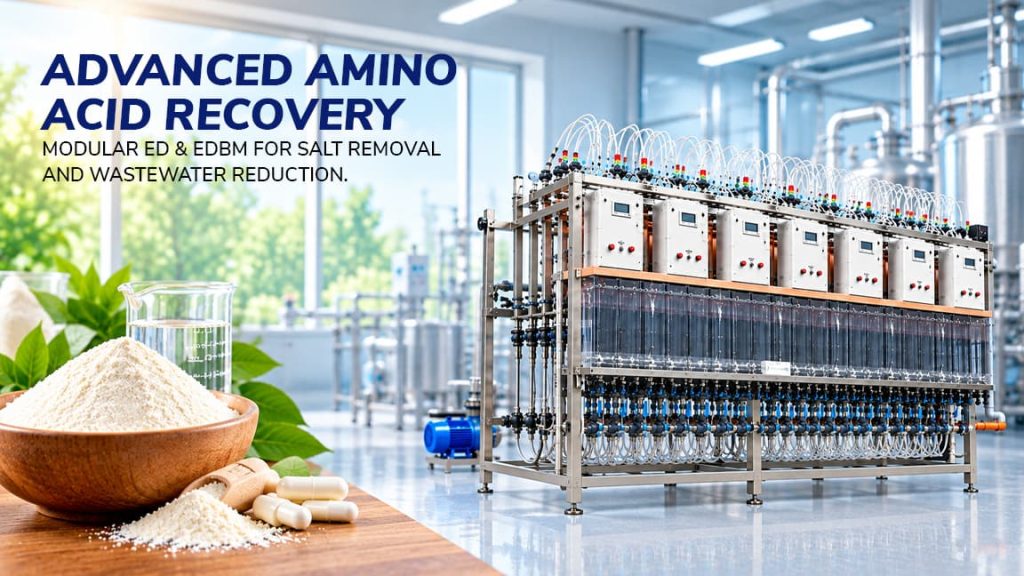
Electrodialysis for amino acid production separates amino acids from mineral salts such as sodium chloride. It can convert amino acid salt streams into purer amino acid products while reducing chemical consumption, wastewater, and salt discharge. With suitable membranes, pH control, and staged operation, ED supports commercial and pilot-scale fine-chemical production.
Why are amino acid salt streams difficult to process?
Amino acid production often creates a salty mother liquor. The amino acid is valuable. The sodium chloride is usually not.
Electrodialysis for amino acid production helps separate these two fractions using ion-exchange membranes and an electrical driving force. That can improve product recovery while reducing the burden on evaporation, ion exchange, and wastewater treatment.
At Laxminarayan Technologies, we design modular ED and EDBM plants for amino acids, fermentation products, specialty chemicals, and pharmaceutical intermediates. We focus on the actual feed stream, not a neat laboratory solution that behaves perfectly until Monday morning.
The process challenge is clear: remove NaCl without losing too much amino acid, damaging product quality, or creating another difficult brine stream.
What is electrodialysis for amino acid production?
Electrodialysis is an electrochemical separation process that moves charged species through alternating cation-exchange and anion-exchange membranes under direct current. In amino acid processing, the stack can separate mineral ions from an amino acid-containing solution while producing a diluate and a concentrate stream.
The separation depends on pH because amino acids change charge around their isoelectric point. Membrane selectivity, molecular structure, concentration, current density, and hydrodynamics also affect the result.
In simple terms, ED uses electricity to sort ions. It does not boil the entire feed, and it does not rely on resin regeneration for every separation cycle.
How to remove NaCl from amino acid mother liquor using electrodialysis
A practical amino acid salt desalination process usually follows these steps:
Characterise the mother liquor. Measure amino acid concentration, NaCl, conductivity, pH, temperature, colour, suspended solids, and organic impurities.
-
Clarify the feed. Remove particles, cells, colloids, and precipitated solids before they enter the stack.
-
Adjust the pH. Set the amino acid charge state to improve salt transport and limit unwanted amino acid migration.
-
Select the membrane arrangement. Use cation and anion membranes according to the amino acid, salt composition, and target purity.
-
Operate below the limiting current. Control current density, voltage, flow rate, and temperature to protect current efficiency.
-
Monitor both streams. Track conductivity, pH, stack voltage, pressure drop, amino acid recovery, and salt concentration.
-
Polish or concentrate the product. Combine ED with evaporation, crystallisation, membrane filtration, or EDBM where appropriate.
The exact pH matters. For an amino acid near its isoelectric point, the molecule may carry little net charge and remain more easily in the product stream. Move too far away from that point and the amino acid can become more mobile. That is when the recovery numbers start getting argumentative.
Why isoelectric point pH control matters
The isoelectric point is the pH at which an amino acid has approximately zero net electrical charge. At or near this condition, amino acid migration can decrease, while sodium and chloride continue moving through the ion-exchange membrane system.
However, the best pH is not identical for every amino acid. Threonine, phenylalanine, lysine, glutamic acid, and other products each have different charge behaviour and solubility.
A pilot study should establish:
-
Amino acid recovery at different pH values
-
NaCl removal and current efficiency
-
Product concentration and crystallisation behaviour
-
Membrane adsorption or colour fouling
-
Required cleaning frequency
-
Final wastewater and concentrate composition
ED versus ion exchange for threonine and phenylalanine desalination
Ion exchange and electrodialysis can both support amino acid purification, but they behave differently in operation.
|
Factor |
Electrodialysis |
Ion exchange |
|
Separation force |
Electrical potential |
Chemical affinity |
|
Main consumables |
Electricity, membranes, cleaning chemicals |
Resin, regenerants, rinse water |
|
Salt handling |
Produces a concentrate stream |
Produces regeneration effluent |
|
Continuous operation |
Possible with suitable design |
Possible with multiple resin beds |
|
Product selectivity |
Controlled through charge and membrane choice |
Controlled through resin chemistry |
|
Key operating issue |
Fouling, scaling, current efficiency |
Resin exhaustion and regeneration |
|
Best fit |
Large ionic loads and salt removal |
Polishing and selective adsorption |
ED does not automatically replace ion exchange. In many plants, the strongest process uses both. ED handles bulk salt removal, while ion exchange or crystallisation provides final polishing.
For threonine or phenylalanine, membrane selection should consider molecular size, charge state, solubility, and the amount of product allowed in the concentrate. A membrane that performs well with sodium chloride may not give the same selectivity in a complex fermentation liquor.
How does an ED stack improve amino acid recovery?
A standard ED stack contains alternating cation-exchange membranes and anion-exchange membranes. Cations move toward the cathode through cation-selective membranes. Anions move toward the anode through anion-selective membranes. The stack creates adjacent diluate and concentrate channels.
In amino acid salt desalination, sodium and chloride can be transferred out of the product stream. Depending on pH, the amino acid may remain mainly in the diluate or may migrate partly with the salt.
The useful design variables include:
-
Number of cell pairs
-
Membrane area and resistance
-
Feed and concentrate flow rates
-
Current density and voltage
-
pH and temperature
-
Initial salt and amino acid concentration
-
Batch or continuous operating mode
-
Product recovery target
According to membrane-process research, current efficiency falls when operation exceeds the limiting current. Water splitting, concentration polarisation, electro-convection, heating, and membrane fouling can then consume energy without delivering proportional salt removal.
That is why stack voltage matters. It should not rise quietly in the background like a pump that has decided to work overtime.
Laxminarayan Technologies supplies fully automated, touch-operated ED plants with recipe control, conductivity monitoring, flow control, pH measurement, alarms, and data logging. We build systems for pilot validation as well as commercial production.
Can EDBM produce amino acids from amino acid salts?
Bipolar electrodialysis can split water into hydrogen and hydroxide ions. When combined with cation- and anion-exchange membranes, it can convert suitable salt solutions into acid and alkali streams.
For amino acid production, this may allow an amino acid salt to be converted into the corresponding free amino acid while forming a sodium hydroxide or related alkaline stream. The precise chemistry depends on the amino acid salt, feed concentration, membrane configuration, and desired product form.
A typical EDBM process may include:
Feed the amino acid salt solution into the appropriate compartment.
-
Apply direct current across the bipolar membrane stack.
-
Generate hydrogen ions and hydroxide ions through water dissociation.
-
Convert the salt form into free amino acid and an alkaline by-product.
-
Control pH and conductivity in each circulation loop.
-
Recover, concentrate, crystallise, or dry the amino acid product.
EDBM is not a universal replacement for acidification and neutralisation. It can reduce chemical handling in the right process, but membrane stability, organic fouling, current efficiency, and product purity must be checked in pilot trials.
Applications for ED and EDBM in fine chemicals
An electrodialysis plant for fine chemicals and fermentation can support several applications:
-
Amino acid salt desalination: Remove NaCl from threonine, phenylalanine, lysine, or other amino acid streams.
-
Fermentation mother-liquor recovery: Reduce salt loading before concentration or crystallisation.
-
Amino acid yield improvement: Recover product that would otherwise leave with wastewater or brine.
-
Organic acid production: Convert organic acid salts into free acids using EDBM.
-
Chemical wastewater recovery: Separate acids, alkalis, and dissolved salts before ZLD treatment.
Our amino acid production application explains how ED technology can be applied to amino acid salt streams.
The same platform can be adapted for organic acid production from organic acid salts and acid recovery from aluminum foil pickling. The chemistry changes, but the engineering discipline stays the same: characterise the feed, define the product target, and size the stack from measured data.
Challenges and solutions in amino acid recovery
Membrane fouling
Fermentation liquors contain proteins, peptides, pigments, cells, colloids, and residual nutrients. These materials can attach to membrane surfaces and increase electrical resistance.
The effect resembles a filter clogging from the inside out. Flow may continue, but the stack needs more voltage to do the same job.
We manage the risk through clarification, pretreatment, controlled flow, membrane selection, online conductivity monitoring, and planned CIP. A clean-stack baseline also helps operators spot performance loss early.
Amino acid loss
Amino acids can migrate through membranes depending on pH, charge, molecular weight, and concentration. Small or strongly charged molecules may move faster than expected.
We address this through pH optimisation, staged desalination, lower current density where appropriate, selective membrane testing, and recovery of the concentrate stream for further processing.
Scaling and current efficiency
Mineral deposits can form when local concentration and pH conditions shift near the membrane surface. Operation above the limiting current can worsen water splitting and reduce useful current efficiency.
Our systems monitor stack voltage, current, conductivity, pH, flow, pressure, and temperature. That information supports automatic alarms and controlled shutdowns before a small deposit becomes a full maintenance job.
Conclusion
Electrodialysis for amino acid production can remove NaCl from amino acid mother liquor, reduce chemical consumption, and improve recovery before crystallisation or drying. EDBM adds another route by converting suitable amino acid salts into free amino acids and alkaline streams.
The result depends on pH, membrane selection, current density, pretreatment, and cleaning. Laxminarayan Technologies develops modular ED and EDBM plants for pilot and commercial fine-chemical production, with application-tailored automation and touch-operated control. We can help test your feed and build the process around your actual yield and wastewater targets.
FAQs
How does electrodialysis remove NaCl from amino acid mother liquor?
Electrodialysis applies direct current across alternating cation- and anion-exchange membranes. Sodium and chloride ions move into a concentrate stream, while the amino acid remains mainly in the diluate when pH and membrane selection are suitable. The final recovery depends on amino acid charge, feed composition, current density, and membrane selectivity.
Is electrodialysis better than ion exchange for amino acid desalination?
Electrodialysis can be preferable for bulk salt removal because it does not require repeated resin regeneration. Ion exchange may still be useful for final polishing or selective separation. The best choice depends on salt concentration, amino acid value, wastewater cost, product purity, and whether the plant needs continuous or batch operation.
Can EDBM convert amino acid salts into free amino acids?
Yes, EDBM can convert suitable amino acid salt solutions into free amino acids by using bipolar membranes to split water and generate hydrogen and hydroxide ions. The process requires careful control of pH, membrane compatibility, current efficiency, and organic fouling. Pilot trials should confirm product purity and recovery.
How can an amino acid plant reduce wastewater cost with ED?
ED can transfer dissolved salts into a controlled concentrate stream, reducing the chemical regeneration effluent associated with some ion-exchange processes. The concentrate may be recovered, treated, or sent to ZLD. Actual wastewater savings depend on feed composition, recovery targets, cleaning frequency, and the final concentrate-disposal route.