
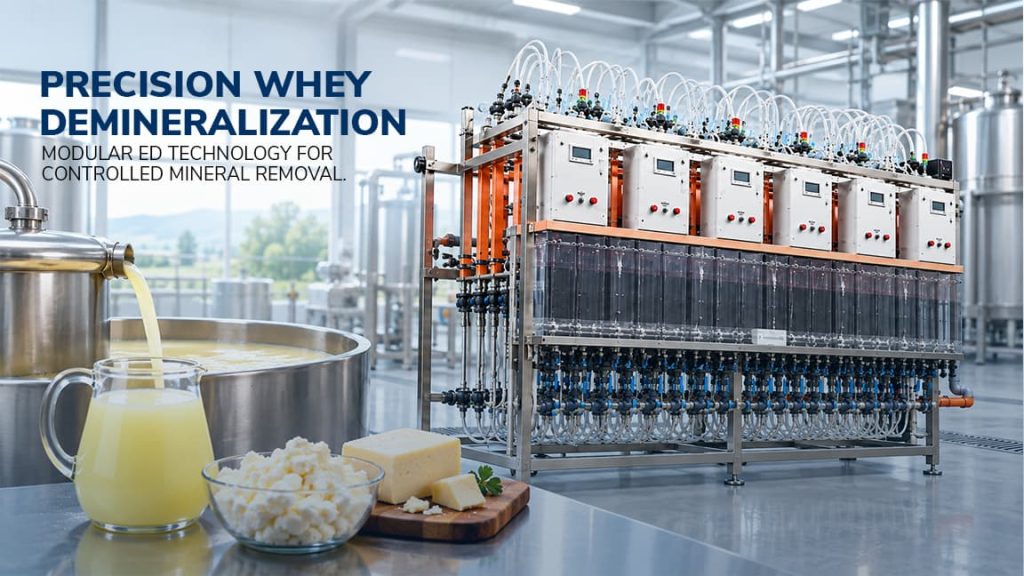
Electrodialysis for cheese whey desalination removes charged minerals such as sodium chloride, calcium, magnesium, and potassium while retaining much of the lactose and protein fraction. With suitable pretreatment, membrane selection, current control, and cleaning, ED can support whey powder, WPC, WPI, and ingredient production at pilot and commercial scale.
Cheese whey can look harmless. It isn’t.
Electrodialysis for cheese whey desalination helps dairy plants reduce mineral ash, sodium chloride, and other dissolved ions before concentration or spray drying. This matters because excess salts can affect taste, powder solubility, drying behaviour, and the commercial value of whey ingredients.
At Laxminarayan Technologies, we design modular ED plants for dairy streams, including pilot systems and fully automated commercial units. The process is not a magic box. Feed quality, pretreatment, membrane chemistry, current density, and cleaning discipline decide whether the stack runs smoothly or starts behaving like a clogged filter.
What is electrodialysis for cheese whey desalination?
Electrodialysis is an electrically driven separation process. It uses alternating cation-exchange membranes and anion-exchange membranes to move positively and negatively charged ions into a concentrate stream. The treated whey remains in the dilute stream, with a lower mineral load.
The stack does not remove neutral lactose in the same way it removes ions. That selectivity is the main reason ED is useful for whey demineralization. The target is controlled salt removal, not indiscriminate removal of everything valuable.
Why does whey need demineralization?
Whey composition changes with cheese type, milk quality, acidification method, and whether the stream is sweet whey, acid whey, salty whey, permeate, or retentate.
A dairy process engineer normally looks at:
-
Ash and total mineral content
-
Sodium and chloride concentration
-
Calcium, magnesium, and potassium
-
Lactic acid and phosphate
-
Protein, lactose, and total solids
-
Conductivity, pH, temperature, and suspended solids
High mineral content can limit evaporation and spray drying. Acid whey brings another problem: lactic acid and calcium can increase scaling risk. Salty whey may carry too much sodium chloride for direct use in a food-ingredient process.
According to research in Journal of Dairy Science, ED configurations have achieved around 67% demineralization and 44% deacidification in acid whey trials. Other studies have reported up to 87% removal based on total cation concentration under specific laboratory conditions. Those figures are useful benchmarks, not promises for every plant. Your feed decides the design.
How to demineralize cheese whey using electrodialysis
A practical process usually follows these steps:
Characterise the whey. Test conductivity, ash, ions, protein, lactose, pH, temperature, and suspended solids.
-
Pre-treat the feed. Use clarification, microfiltration, ultrafiltration, or nanofiltration where needed to reduce fat, protein fines, and particulate loading.
-
Select the membrane stack. Choose cation and anion membranes based on the target ions, food-contact requirements, temperature, and cleaning chemistry.
-
Run under controlled current. Stay near, but generally below, the limiting current density unless the design specifically supports another operating mode.
-
Monitor the dilute and concentrate. Track conductivity, pH, stack voltage, current efficiency, flow, and pressure drop.
-
Clean on schedule. Water rinsing and chemical cleaning prevent small deposits from becoming expensive downtime.
A typical research setup has used current densities around 100 A/m², while actual industrial values depend on membrane area, feed conductivity, flow velocity, temperature, and stack geometry.
How does a dairy ED plant remove salts?
The ED stack contains repeating cell pairs. Each pair has a dilute channel and a concentrate channel. Under direct current, cations move toward the cathode and anions move toward the anode. The membranes guide those ions into the concentrate channel.
The treated stream is called the dilute. The ion-rich stream is the concentrate or brine.
This arrangement allows salt removal without boiling the whey. That can reduce thermal exposure and help preserve the functionality of proteins and lactose, provided the feed is not overheated and the system is properly controlled.
For plants targeting acid recovery or pH adjustment, bipolar electrodialysis adds another option. A bipolar membrane splits water into hydrogen and hydroxide ions, allowing the production of acid and alkali from suitable salt streams.
ED compared with EDBM
|
Feature |
Conventional ED |
Bipolar EDBM |
|
Main function |
Removes ions into a concentrate stream |
Converts salts into acid and alkali streams |
|
Membranes |
Cation and anion exchange membranes |
Cation, anion, and bipolar membranes |
|
Whey application |
Demineralization and desalting |
Deacidification, pH correction, acid or base production |
|
Main output |
Lower-ash whey plus concentrate |
Acid and alkali streams, plus treated feed |
|
Key control point |
Current density and scaling |
Water splitting, pH, current efficiency, and scaling |
Laxminarayan Technologies builds application-tailored ED and EDBM systems with automated dosing, pumps, sensors, recipe control, and touch-operated interfaces. The exact stack configuration should follow your target product, not a catalogue number.
Where is whey desalting used?
Whey desalting is usually part of a wider dairy-ingredient process rather than a standalone treatment.
Common applications include:
-
Whey powder production: Lower mineral content can improve taste, drying performance, and powder specifications.
-
WPC and WPI processing: ED can polish a suitable permeate or pretreated stream before concentration and drying.
-
Cheddar and other salty whey streams: ED can reduce sodium chloride load before reuse or ingredient processing.
-
Acid whey treatment: ED can remove minerals and support lactic acid recovery before spray drying.
-
Food and pharmaceutical ingredients: Controlled demineralization can help meet formulation and purity requirements.
For a dairy-specific example, see our application page for desalination of cheese whey.
The same membrane platform can also support other ionic separations. For example, our soy sauce desalination application addresses a different food stream with a similar need for controlled salt removal. In chemical plants, ED and EDBM can recover acid, alkali, or organic acids from salt solutions. See our applications for aluminum foil pickling acid recovery and organic acid production from organic acid salts.
What challenges affect ED performance?
Membrane fouling
Whey contains proteins, peptides, lipids, and other organic compounds. Some can attach to anion-exchange membranes and increase electrical resistance. It is similar to a filter slowly closing up, except the pressure gauge is replaced by rising stack voltage.
Clarification and membrane pretreatment help. So do suitable flow velocities, controlled solids loading, and a cleaning programme based on actual conductivity and pressure trends.
Scaling from calcium and magnesium
Calcium phosphate, calcium carbonate, and magnesium-containing deposits can form near membrane surfaces. Concentration polarisation and local pH changes make the problem worse, particularly near the limiting current.
We address this through feed conditioning, hydrodynamic control, current management, suitable concentrate chemistry, and planned CIP. Pulsed electric field operation has reduced scaling and energy consumption in some acid whey studies, but it requires proper validation. It is not a button you press because the brochure used the word “advanced.”
Stack voltage and current efficiency
As the feed becomes less conductive, stack voltage can creep upward like a stressed pump climbing its curve. That usually signals increased resistance, concentration polarisation, fouling, scaling, or an unsuitable operating point.
Our automated systems monitor:
-
Stack voltage and current
-
Feed and concentrate conductivity
-
pH and temperature
-
Flow and pressure
-
Batch time and demineralization level
-
Cleaning triggers and alarm conditions
Pilot testing remains important. A small trial can establish current density, membrane area, recovery, energy demand, and cleaning frequency before you commit to a commercial plant.
Is an energy-saving whey desalination plant possible?
Yes, but energy consumption depends on the amount and type of salt removed, feed concentration, conductivity, membrane resistance, current efficiency, flow conditions, and pretreatment.
Published studies show that current density strongly affects both processing time and energy consumption. In one acid whey study, reverse-osmosis pretreatment changed the energy requirement by up to twofold under the tested conditions. That is why we avoid quoting a universal kWh/m³ number without analysing the actual feed.
A correctly designed system can reduce unnecessary thermal processing, recover useful concentrate streams, and operate automatically with limited operator intervention. The best design is the one that meets your ash, sodium, conductivity, and powder-quality targets with acceptable cleaning and operating costs.
Conclusion
Electrodialysis for cheese whey desalination gives dairy processors a selective way to reduce dissolved minerals while retaining valuable lactose and protein fractions. Its performance depends on feed preparation, membrane selection, current control, hydrodynamics, and disciplined CIP, not on the stack alone.
Laxminarayan Technologies supplies modular, fully automated, touch-operated ED and EDBM plants for pilot trials and commercial production. We can help evaluate your whey stream, define the treatment target, and develop a system around the product you actually need to make.
FAQs
How much salt can electrodialysis remove from cheese whey?
The removal level depends on whey type, pretreatment, membrane arrangement, current density, operating time, and the required final conductivity. Published studies have achieved roughly 67% to 87% demineralization under specific acid whey conditions. A target above 95% may be possible in a staged or tailored process, but it must be confirmed through pilot testing.
Can electrodialysis remove sodium chloride from salty whey?
Yes. ED moves sodium and chloride ions through selective ion-exchange membranes into a concentrate stream. The practical result depends on the initial salt level, protein and solids content, membrane selectivity, and fouling control. For high-salt whey, pretreatment and staged operation may be needed to protect current efficiency and reduce energy use.
Is EDBM suitable for whey deacidification?
EDBM can be suitable where the process requires pH adjustment or acid and alkali generation from a salt stream. Bipolar membranes split water into hydrogen and hydroxide ions, which can help convert suitable salts into acid and base. The whey chemistry, organic load, scaling tendency, and product specifications must be assessed first.
What pretreatment is recommended before whey demineralization?
The right pretreatment depends on the feed. Clarification, microfiltration, ultrafiltration, or nanofiltration may be used to reduce suspended solids, fat, protein fines, or microbial load before ED. The goal is not to remove valuable material unnecessarily. It is to present the stack with a cleaner, more stable feed.