
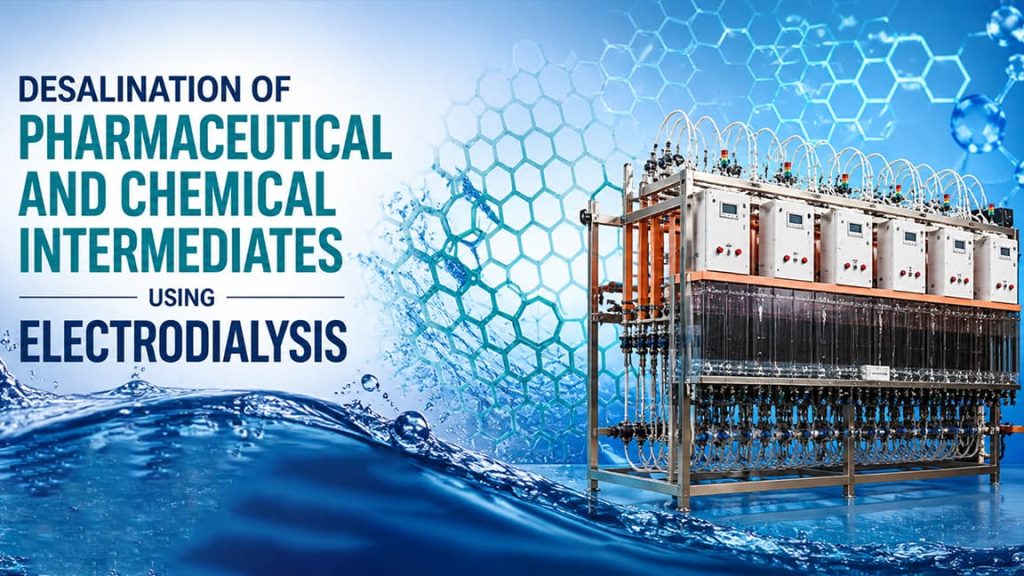
Pharmaceutical and chemical manufacturing often involves valuable process streams that contain salts, unwanted ions, solvents, proteins, or other impurities. Removing these ionic components without losing the target product is a major downstream-processing challenge.
Traditional methods such as ion exchange, dialysis, precipitation, and repeated washing can increase chemical consumption, product loss, wastewater generation, and operating complexity. Electrodialysis for desalination of pharmaceutical and chemical intermediates offers a selective membrane-based alternative designed to remove unwanted ions while retaining valuable molecules in the product stream.
The technology is especially relevant for pharmaceutical intermediates, fermentation-derived products, amino acids, organic acids, proteins, dextrans, and specialty chemicals.
Explore the Pharmaceutical and Chemical Intermediate Desalination Application.
What Is Desalination of Pharmaceutical Intermediates?
Desalination is the controlled removal of dissolved salts and ionic impurities from a pharmaceutical or chemical process stream.
During synthesis, fermentation, neutralisation, extraction, or purification, the product may remain mixed with:
-
Sodium chloride
-
Organic-acid salts
-
Inorganic ions
-
Residual process chemicals
-
Buffer components
-
Unwanted counterions
-
Low-molecular-weight ionic impurities
The objective is to reduce these unwanted components while preserving the valuable product, yield, concentration, and functional properties.
Why Desalination Matters in Pharmaceutical Processing
Salt removal is often essential before crystallisation, drying, formulation, concentration, or final purification. Excess ionic content can affect:
-
Product purity
-
Crystallisation behaviour
-
Stability
-
Taste and formulation properties
-
Downstream membrane performance
-
Drying cost
-
Solvent recovery
-
Regulatory specifications
-
Overall process yield
A suitable desalination process can simplify downstream operations and reduce the burden on later purification steps.
How Electrodialysis Works
Electrodialysis is an electrically driven membrane separation process. It uses alternating cation-exchange and anion-exchange membranes arranged inside a membrane stack.
When direct current is applied:
-
Cations move toward the cathode.
-
Anions move toward the anode.
-
Cation-exchange membranes allow selected positive ions to pass.
-
Anion-exchange membranes allow selected negative ions to pass.
-
The feed is separated into a product stream and a concentrate stream.
The target molecule can remain in the product stream while salts and unwanted ionic components migrate through the membranes.
Because electrodialysis removes ions rather than relying on evaporation, it can be suitable for heat-sensitive pharmaceutical and biochemical materials.
Why Electrodialysis Is Useful for Valuable Product Streams
Pharmaceutical intermediates and bioproducts can be expensive to manufacture. Losing even a small quantity of product during desalination can affect the economics of the complete process.
Electrodialysis can help by providing:
-
Selective removal of ionic impurities
-
Lower product loss in suitable applications
-
Reduced chemical consumption
-
Lower thermal exposure
-
Continuous or batch operation
-
Scalable membrane-stack design
-
Better control of desalination intensity
-
Potential reduction in wastewater treatment load
The actual performance depends on the molecular structure, charge behaviour, conductivity, concentration, pH, viscosity, and impurity profile of the feed.
Pharmaceutical Applications of Electrodialysis
Electrodialysis has several potential applications in pharmaceutical and biotechnology processing.
Desalination of Fermentation Broths
Fermentation broths may contain valuable products along with salts, proteins, sugars, cells, and suspended solids. Electrodialysis can be evaluated as part of the downstream process after suitable clarification or filtration.
Recovery of Lactic Acid
Lactic acid recovery from fermentation broth is one example of an application where desalination and product recovery are closely connected.
Removing salts from the broth can improve downstream processing and reduce the amount of waste requiring treatment.
Desalination of Amino Acids
Amino acids are amphoteric molecules containing both acidic and basic functional groups. Electrodialysis can be used for desalination of selected amino-acid streams, with pH adjustment helping to minimise product loss.
The Amino Acid Desalination Application includes examples such as lysine, threonine, phenylalanine, glycine, glutamine, arginine, tryptophan, leucine, serine, and other amino-acid products.
Desalination of Proteins and Dextrans
Some protein and dextran solutions contain valuable high-molecular-weight products mixed with salts and low-molecular-weight impurities.
Electrodialysis can be considered when the target molecule can be retained while ionic components are selectively removed.
Pharmaceutical Intermediates
Pharmaceutical intermediates may require desalting before crystallisation, solvent exchange, drying, or final purification. Electrodialysis can be integrated with other downstream technologies according to the chemical properties of the product.
Chemical Intermediate Desalination
Chemical intermediates can contain salts generated during synthesis, neutralisation, hydrolysis, or separation. If these salts are not removed efficiently, they may increase processing costs and complicate final purification.
Electrodialysis can support:
-
Salt removal
-
Deionisation
-
Desalting of organic compounds
-
Product recovery
-
Stream concentration
-
Process-water reduction
-
Improved downstream crystallisation
The technology can be evaluated for specialty chemicals, organic acids, amino-acid derivatives, pharmaceutical building blocks, and other charged or partially charged products.
Electrodialysis Compared with Ion Exchange
Ion exchange has been used widely for desalination and purification. However, it may require resin regeneration, chemical washing, and additional wastewater treatment.
Electrodialysis offers a different operating model based on membrane separation and electrical driving force.
Factor Electrodialysis Ion Exchange
Separation principle Electric field and ion-selective membranes
Reversible ion exchange on resin
Chemical regeneration May be reduced, depending on process Usually required
Waste generation Concentrate stream and cleaning streams Regeneration wastewater and spent chemicals
Product loss Can be low in suitable applications Depends on resin and process chemistry
Thermal exposure Generally low Generally low
Process control Current, voltage, flow, conductivity, pH Resin capacity, flow, regeneration cycle
Scalability Membrane area can be increased Resin volume and column design
Suitability Charged ionic species Ion-exchangeable components
The best choice should be based on pilot testing, feed chemistry, product value, purity requirements, and total process economics.
Frequently Asked Questions
Q: What is pharmaceutical intermediate desalination?
Ans: Pharmaceutical intermediate desalination is the removal of unwanted salts and ionic impurities from a pharmaceutical process stream while retaining the valuable intermediate.
Q: How does electrodialysis remove salts?
Electrodialysis uses direct current and ion-exchange membranes to move cations and anions out of the product stream into a separate concentrate stream.
Q: Can electrodialysis be used for fermentation products?
Yes. It can be evaluated for fermentation-derived products such as lactic acid, amino acids, proteins, and other valuable biochemical compounds.
Q: Is electrodialysis suitable for heat-sensitive products?
It can be suitable because it does not rely on boiling or evaporation. Final suitability depends on the product’s charge, membrane compatibility, temperature sensitivity, and operating conditions.
Q: What types of impurities can electrodialysis remove?
It is primarily designed to remove charged ions, salts, and selected ionic impurities. Neutral molecules are not removed in the same way.
Q: Can electrodialysis reduce product loss?
It can reduce product loss in suitable applications when the target molecule is retained effectively by the process conditions. Pilot testing is required to confirm recovery.
Q: Is pretreatment required?
Often, yes. Suspended solids, proteins, oils, colloids, and fouling compounds may require filtration, microfiltration, ultrafiltration, or another pretreatment step before electrodialysis.
Q: Can electrodialysis be used for amino-acid desalination?
Yes. pH adjustment can help reduce amino-acid loss by controlling the charge state of the molecule during desalination.
Q: Is electrodialysis better than ion exchange?
Not automatically. Electrodialysis can offer advantages in selected applications, but the correct technology depends on the feed composition, target product, purity requirement, process economics, and pilot results.
Q: Are pilot Trials necessary?
Yes. Pilot trials, at our works only, help establish membrane compatibility, product recovery, salt-removal efficiency, power consumption, fouling behaviour, and scale-up requirements.
We do not supply Pilot plants.
Important Process Parameters
The success of a pharmaceutical or chemical desalination system depends on several operating variables.
Feed Conductivity
Electrodialysis requires sufficient ionic conductivity for efficient current transfer. Very low conductivity can increase electrical resistance and reduce process efficiency.
Product Charge
The target molecule’s charge state influences whether it will pass through the membrane or remain in the product stream. pH control is often essential.
Molecular Size
Large molecules such as proteins and dextrans may behave differently from small ions and low-molecular-weight compounds. Membrane selection and process conditions must be validated accordingly.
pH
pH affects molecular charge, membrane transport, product stability, and recovery. For amphoteric compounds such as amino acids, pH can be particularly important.
Temperature
Temperature influences viscosity, conductivity, membrane performance, and product stability. Heat-sensitive products require controlled operating conditions.
Suspended Solids
Suspended solids and colloids can contribute to membrane fouling. Suitable clarification and filtration are often necessary before the feed enters the electrodialysis stack.
Flow Rate
Flow rate affects concentration polarisation, pressure drop, residence time, and overall desalination performance.
Current Density
Current density must be controlled to balance ion removal, power consumption, water splitting, membrane stress, and product quality.
Why Pretreatment Is Critical
Membrane fouling is one of the main challenges in any membrane-based process. Pharmaceutical and fermentation streams may contain:
-
Proteins
-
Cell debris
-
Pigments
-
Oils
-
Colloids
-
Suspended solids
-
High-molecular-weight impurities
Depending on the feed, pretreatment may include:
-
Clarification
-
Microfiltration
-
Ultrafiltration
-
Activated carbon treatment
-
pH adjustment
-
Precipitation
-
Cartridge filtration
For example, certain amino-acid streams containing salts, suspended solids, proteins, and saccharides may benefit from ultrafiltration before electrodialysis.
The right pretreatment sequence should be established through feed analysis and pilot trials.
Modern Technology Trends in Pharmaceutical Desalination
The pharmaceutical and biotechnology industries are moving toward more selective, lower-waste, and data-controlled downstream processing.
Membrane-Based Separation
Electrodialysis, nanofiltration, ultrafiltration, and related membrane technologies are increasingly combined to create integrated purification trains.
Continuous Downstream Processing
Electrodialysis can be designed for batch or continuous operation, depending on feed characteristics and plant capacity.
Automated Process Control
Modern systems can monitor and control:
-
Voltage
-
Current
-
Flow rate
-
Pressure
-
Temperature
-
Conductivity
-
pH
-
Product concentration
-
Desalination endpoint
Digital Batch Recipes
Automated recipes can help operators reproduce validated processing conditions across different batches.
Lower Waste Processing
Selective desalination can reduce the need for repeated washing, chemical neutralisation, and solvent-intensive purification in suitable applications.
Process Intensification
Combining electrodialysis with filtration, crystallisation, nanofiltration, or evaporation can reduce the number of separate processing steps.
Resource Recovery
The concentrate stream may contain recoverable salts, chemicals, or by-products. Its treatment and potential reuse should be considered during plant design.
Related Electrodialysis Applications
Organisations interested in pharmaceutical or chemical intermediate desalination may also evaluate the following applications.
Amino Acid Production from Amino Acid Salts
Electrodialysis for Amino Acid Desalination supports the removal of sodium chloride from amino-acid mother liquors.
The application includes pH-based strategies to reduce amino-acid loss during processing.
Organic Acid Production
Production of Organic Acids from Organic Acid Salts uses electrodialysis or bipolar electrodialysis for selected organic-acid conversion and desalting processes.
Applications may include lactic acid, citric acid, gluconic acid, acetic acid, formic acid, propionic acid, salicylic acid, and other organic acids.
Fruit Juice and Wine Processing
Electrodialysis for Fruit Juice Desalination and Wine De-acidification can be evaluated for the controlled removal of salts and tartaric acid from beverage streams.
Cheese Whey Desalination
Electrodialysis for Cheese Whey Desalination is used to reduce mineral salts in whey before further dairy processing.
Soy Sauce Desalination
Electrodialysis for Soy Sauce Desalination can reduce salt content while helping retain important flavour, colour, and aroma characteristics.
Phase Transfer Catalyst Manufacture
Electrodialysis for Phase Transfer Catalyst Manufacture supports the manufacture or purification of selected onium hydroxides used in chemical synthesis, semiconductor processing, and specialty chemicals.
Colloidal Silica Manufacture
Colloidal Silica Manufacture Using Electrodialysis uses the Electrosol process for sodium silicate dealkalisation, silica sol production, filtrate recycling, and potential caustic soda recovery.
Electrodialysis Machines and Applications
Explore the complete Electrodialysis Machines and Applications portfolio for pharmaceutical, chemical, food, beverage, organic-acid, desalination, and resource-recovery applications.
Global Use in Pharmaceutical and Chemical Manufacturing
Electrodialysis is relevant to pharmaceutical, biotechnology, specialty chemical, food, and biochemical manufacturers across global markets.
For international projects, a suitable system should consider:
-
Local pharmaceutical regulations
-
Good Manufacturing Practice requirements
-
Hygienic equipment design
-
Material compatibility
-
Cleaning and sanitisation procedures
-
Validation requirements
-
Electrical standards
-
Product containment
-
Operator training
-
Membrane servicing
-
Waste-stream management
-
Documentation and traceability
A global process solution must be customised to the actual feed and product rather than copied from an unrelated installation.
How to Select the Right Electrodialysis System
Before selecting a commercial desalination plant, assess:
-
Feed composition: Analyse salts, organic compounds, proteins, sugars, suspended solids, pigments, and other impurities.
-
Target molecule: Determine its molecular size, charge behaviour, pKa, stability, and concentration.
-
Desalination objective: Define the required salt-removal percentage and final product specification.
-
Product recovery: Establish the acceptable product loss during the process.
-
Pretreatment: Identify whether clarification, microfiltration, ultrafiltration, or another step is required.
-
Membrane selection: Confirm compatibility with the feed, product, cleaning agents, and operating temperature.
-
Operating mode: Choose between batch, semi-continuous, or continuous processing.
-
Concentrate handling: Plan recovery, reuse, treatment, or disposal of the concentrate stream.
-
Cleaning strategy: Define cleaning chemicals, frequency, flushing procedures, and membrane-protection requirements.
-
Automation: Consider PLC controls, HMI operation, alarms, data logging, and batch records.
-
Regulatory needs: Review validation, material certificates, traceability, and documentation requirements.
-
Scale-up: Use pilot data to determine membrane area, stack configuration, tank size, and utility demand.
Why Pilot Testing Matters
Pharmaceutical and chemical streams are highly variable. Two products with similar names may behave very differently inside an electrodialysis stack.
Pilot testing can establish:
-
Salt-removal efficiency
-
Product recovery
-
Membrane compatibility
-
Fouling tendency
-
Current efficiency
-
Energy consumption
-
pH operating range
-
Temperature requirements
-
Pretreatment performance
-
Cleaning requirements
-
Concentrate composition
-
Scale-up parameters
A pilot study is particularly important when the product is high value, heat sensitive, biologically active, or intended for a regulated market.
Turnkey Project Support
A complete electrodialysis project may include:
-
Feed analysis
-
Process selection
-
Pilot-plant testing at our works only.
-
Membrane-stack selection
-
Process-flow design
-
Feed and product tanks
-
Pumps and piping
-
Pretreatment systems
-
Electrical and control systems
-
PLC and HMI integration
-
Cleaning systems
-
Plant erection
-
Commissioning
-
Operator training
-
Process documentation
Laxminarayan Technologies provides electrodialysis and bipolar electrodialysis solutions for pharmaceutical, chemical, food, beverage, recovery of pickling acids and specialty chemical applications.
The Future of Pharmaceutical Intermediate Desalination
The future of downstream processing is moving toward selective separation, lower product loss, reduced wastewater, and better digital control.
Electrodialysis fits this direction by offering:
-
Ion-selective separation
-
Low-temperature operation
-
Scalable membrane technology
-
Flexible batch or continuous processing
-
Reduced chemical dependency
-
Integration with filtration and crystallisation
-
Better process monitoring
-
Potential resource recovery
For pharmaceutical and chemical manufacturers, the real value is not simply removing salt. It is building a more efficient and controlled purification process around a valuable product stream.
Conclusion
Electrodialysis provides a modern solution for the desalination of pharmaceutical intermediates and chemical intermediates.
By using ion-exchange membranes and controlled electrical separation, the process can remove unwanted salts and ionic impurities while helping preserve valuable products. It can be applied to fermentation products, amino acids, proteins, dextrans, organic acids, pharmaceutical intermediates, and specialty chemicals.
The right system depends on the feed chemistry, product charge, molecular size, target purity, pretreatment requirements, membrane compatibility, and pilot-test results.
Explore the Pharmaceutical and Chemical Intermediate Desalination Application or visit the Electrodialysis.in homepage to discuss laboratory testing, pilot plants, and commercial-scale process solutions.