
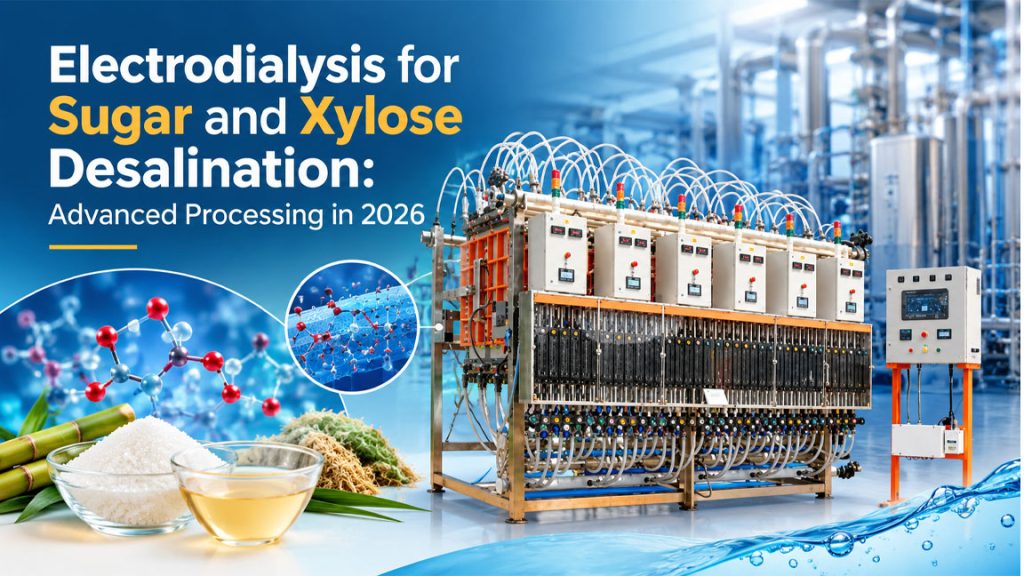
Electrodialysis for sugar and xylose desalination removes dissolved salts, acids, and mineral ions from xylose, xylitol, starch sugar, and oligosaccharide streams. Because neutral sugars usually remain in the dilute, ED can reduce ash and conductivity with limited carbohydrate loss. It also cuts chemical regeneration, wastewater, and repeated washing.
Why do sugar and xylose streams need desalination?
Sugar is valuable. Salt is usually the baggage.
Hydrolysis, fermentation, neutralisation, and crystallisation can leave xylose, xylitol, starch sugar, soybean saccharides, or xylo-oligosaccharides mixed with inorganic salts and acids. That salt load can affect colour, taste, crystallisation, evaporation, and final product purity.
Electrodialysis for sugar and xylose desalination gives food and sweetener manufacturers a selective way to remove charged impurities without sending the whole sugar stream through another chemical regeneration cycle.
At Laxminarayan Technologies, we design modular ED plants for food, fermentation, sweetener, and fine-chemical processing. Our systems range from pilot units to fully automated commercial plants. The target is not simply lower conductivity. It is better product recovery, lower ash, manageable brine, and a process your operators can actually run.
What is electrodialysis for sugar and xylose desalination?
Electrodialysis is an electrically driven membrane process that separates ions from a liquid. Alternating cation-exchange and anion-exchange membranes form a stack of diluate and concentrate channels. Direct current moves cations and anions through the membranes into the concentrate stream.
Most neutral sugars do not migrate through ion-exchange membranes in the same way as sodium, chloride, sulphate, calcium, or residual acid. That difference allows ED to desalt carbohydrate solutions while retaining much of the sugar in the diluate.
This is the core principle: ED removes electrolytes, while neutral carbohydrates largely remain in the product stream. Actual sugar loss still depends on membrane selection, viscosity, concentration, pH, fouling, and operating time.
How to remove salt from xylo-oligosaccharide using electrodialysis
A practical xylo-oligosaccharide desalination process usually follows these steps:
Test the feed. Measure sugar concentration, salt, ash, conductivity, pH, colour, viscosity, proteins, and suspended solids.
- Pre-filter the solution. Remove fibres, proteins, colloids, and particles before they reach the stack.
- Set the solids level. High viscosity can reduce flow and increase membrane resistance, so dilution may be required.
- Select the membrane stack. Choose food-compatible cation and anion membranes for the ionic composition and target removal.
- Run controlled desalination. Adjust voltage, current density, flow rate, temperature, and treatment time.
- Monitor the diluate and concentrate. Track conductivity, pH, pressure drop, current efficiency, and sugar recovery.
- Concentrate or crystallise. Send the desalted product to evaporation, chromatography, crystallisation, or drying.
The feed chemistry sets the operating window. A thin hydrolysate and a concentrated oligosaccharide syrup are not interchangeable, despite both being “sugar solutions” on a process sheet.
Our application data reports salt removal above 98% for feed streams containing approximately 4% xylo-oligosaccharide and for soybean saccharide streams containing about 2% oligosaccharide. These are application-specific results. Your plant should confirm performance with its own feed.
Xylose deacidification after acid hydrolysis
Acid hydrolysis can produce xylose with residual sulphuric acid or other ionic impurities. Traditional lime neutralisation consumes chemicals and creates additional salts, sludge, and wastewater.
ED can remove residual acid selectively. A published xylitol study reported more than 99% residual-acid removal with an 84.9% xylose recovery at a current density of 30 mA/cm². The same study reported energy consumption of 179 kWh per tonne of hydrolysed solution.
That number belongs to the tested system, not every future plant. Still, it shows why acid removal by ED deserves serious attention before a factory commits to another lime-and-resin loop.
Can ED replace centrifugal washing and recrystallisation?
Sometimes. Not automatically.
Centrifugal washing and recrystallisation can remove salts, but they may require repeated water use, heating, labour, and product handling. Every extra wash also creates a stream containing dissolved sugar. The balance becomes unpleasant quickly.
ED works differently. It removes ions directly through membranes and creates a separate concentrate stream. The sugar stays mainly in the diluate, while the salts move toward the brine loop.
|
Process factor |
Electrodialysis |
Centrifugal washing and recrystallisation |
|
Main separation mechanism |
Ion migration through membranes |
Washing, solid-liquid separation, and crystal formation |
|
Sugar handling |
Product remains mainly in diluate |
Product dissolves and recrystallises |
|
Water demand |
Controlled process streams |
Can be high across repeated washes |
|
Salt removal |
Adjustable through conductivity target |
Depends on washing and crystal purity |
|
Labour requirement |
Automated circulation and monitoring |
More material handling and batch steps |
|
Main risk |
Fouling, scaling, membrane ageing |
Sugar loss, heat load, and repeated handling |
|
Best fit |
Liquid sugar, oligosaccharide, and hydrolysate streams |
Crystalline products with suitable solubility behaviour |
For six-carbon carbohydrate streams containing sugar, inorganic salt, proteins, and suspended solids, ED can replace or reduce the original washing and recrystallisation route after suitable pretreatment. The business case depends on sugar loss, labour, power, water, and final product specifications.
How does an ED plant protect sugar recovery?
A conventional stack contains repeating cell pairs. The cation membrane carries positive ions toward the cathode. The anion membrane carries negative ions toward the anode. The desalinated carbohydrate stream is the diluate; the salt-rich stream is the concentrate.
The important design variables include:
-
Membrane area and cell-pair count
-
Feed conductivity and sugar concentration
-
Flow velocity and spacer geometry
-
Current density and stack voltage
-
Temperature and viscosity
-
Concentrate composition
-
Required ash or conductivity endpoint
-
Batch or continuous operation
According to research on raffinose purification, a desalination ratio of 91.2% was achieved with 94.5% raffinose recovery under reported laboratory conditions. Another soybean oligosaccharide study achieved 94% ion reduction at a working voltage of 20 V and a flow rate of 60 L/h.
The message is straightforward: high salt removal and high sugar recovery can coexist, but only inside a carefully tested operating window.
Laxminarayan Technologies supplies fully automated, touch-operated ED plants with flow control, conductivity probes, current and voltage monitoring, alarms, and recipe-based operation. The control system should show operators what the stack is doing, not make them guess from a single conductivity number.
Where are sugar and xylose desalination systems used?
An ED plant for food and sweetener processing can support several applications:
- Xylo-oligosaccharide desalination: Reduce salts before concentration, drying, or formulation.
- Soybean saccharide desalting: Lower ash and ionic impurities from sweet-slurry extracts.
- Xylitol processing: Remove residual acid after xylose hydrolysis or fermentation.
- Starch sugar demineralization: Reduce calcium, chloride, sulphate, and other mineral ions before refining.
- Sweetener and fermentation streams: Recover salts separately and reduce wastewater loading.
See our application page for starch sugar, soybean saccharide, xylose, and xylitol desalination.
The same ED and EDBM platform can be adapted for amino acid salt desalination or organic acid production from organic acid salts. Different products, same rule: start with a measured feed analysis and a defined purity target.
What challenges affect carbohydrate ED performance?
Membrane fouling
Sugar streams may contain proteins, colour bodies, colloids, suspended solids, and degradation products. These can form a layer on the membrane, much like a filter slowly filling with fine flour.
Pretreatment is the first defence. Clarification, microfiltration, suitable flow velocity, and controlled solids concentration reduce the load. We also use conductivity and voltage trends to identify rising resistance before production performance drops.
Scaling and viscosity
Calcium, magnesium, sulphate, carbonate, and phosphate can precipitate near membrane surfaces. High sugar concentration raises viscosity and makes ion transport harder. The result can be lower current efficiency, slower desalination, and higher power consumption.
Flow design matters. So does temperature. So does not pushing the stack beyond its useful current range because the shift supervisor wants the batch finished before lunch.
Sugar loss and product quality
Although sugars are mostly neutral, some loss can occur through diffusion, water transport, membrane leakage, or entrainment in the concentrate. Colour and flavour compounds may behave differently from the main carbohydrate.
We manage this through membrane screening, staged voltage or current control, product sampling, mass balances, and recovery of the concentrate where practical. A pilot test should measure sugar recovery, ash removal, conductivity, colour, energy, and cleaning frequency together.
Is bipolar electrodialysis useful for sugar processing?
Bipolar electrodialysis uses water splitting to create hydrogen and hydroxide ions. It is most useful when the process needs acid or alkali generation, pH adjustment, or conversion of a salt into a corresponding acid and base.
For xylose and xylitol production, conventional ED is commonly focused on demineralization and deacidification. EDBM becomes attractive when the process also needs chemical recovery or a lower-consumption route for acid-base conversion.
A 2025 study demonstrated bipolar membrane electrodialysis for the simultaneous separation of xylitol, xylonic acid, and potassium hydroxide from a xylose-based process. The optimised system reduced specific energy consumption by 46.4% compared with its standard operating condition.
That is a promising direction, but membrane compatibility and feed chemistry still decide whether the process works economically at plant scale.
Conclusion
Electrodialysis for sugar and xylose desalination can remove salts and acids from xylose, xylitol, starch sugar, soybean saccharide, and xylo-oligosaccharide streams while retaining much of the valuable carbohydrate. It can also reduce repeated washing, chemical regeneration, labour, and wastewater.
High removal targets, including 98% or more in selected application streams, require proper pretreatment and pilot validation. Laxminarayan Technologies develops modular ED and EDBM plants for pilot and commercial sweetener processing, with automated, touch-operated control. We can help define the feed conditions, membrane configuration, recovery target, and process route before you buy a stack that looks impressive but sulks under real syrup.
FAQs
How does electrodialysis remove salt from xylo-oligosaccharide?
Electrodialysis uses alternating cation- and anion-exchange membranes to move sodium, chloride, sulphate, and other charged ions into a concentrate stream. Xylo-oligosaccharides are largely uncharged and remain mainly in the diluate. Actual recovery depends on membrane selection, feed viscosity, solids concentration, conductivity, and operating time.
Can ED achieve 98% salt removal from soybean saccharide?
Yes, application results can exceed 98% salt removal for selected soybean saccharide feeds. The result depends on the original salt concentration, oligosaccharide content, pretreatment, stack design, and endpoint definition. A pilot trial should confirm ion removal, sugar recovery, colour, energy consumption, and membrane cleaning requirements before scale-up.
Is electrodialysis better than recrystallisation for sugar desalting?
ED can reduce water use, repeated heating, labour, and sugar loss associated with washing and recrystallisation. Recrystallisation may still be useful for final crystal purification. The best process depends on whether your product is a liquid syrup, oligosaccharide solution, xylitol stream, or crystalline sugar.
Can ED remove acid from xylose hydrolysate?
Yes. ED can remove residual acid and other ionic impurities from xylose hydrolysate before concentration or crystallisation. Published work reported more than 99% residual-acid removal with 84.9% xylose recovery under defined conditions. The actual result depends on acid type, pH, sugar concentration, membrane stack, and pretreatment.